
Iron Glass 是五频段并联拓扑的母带/混音均衡器,模拟经典无源硬件电路,真实再现电子管、变压器和电感网络的动态染色与频率偏移。
原始标题:Remanence Audio Iron Glass v1.1.6 MacOS
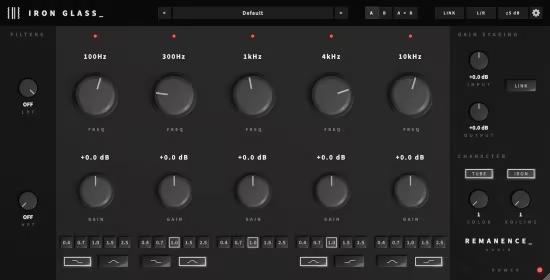
Remanence Audio 推出的 Iron Glass 是一款五频段并联拓扑的模拟电路建模母带/混音均衡器插件,它采用物理电路级建模技术模拟真实电子管、变压器和电感网络。其核心特点是不仅提供动态的染色特性,还能在重负载下重现类似真实硬件的频率偏移和磁滞记忆。
GUISEPPE | 26 July 2026 | 51 MB
IRON GLASS_ is a five-band EQ for mixing and mastering. Instead of running its bands one after another, all five work on the same signal at once and blend back together, the way classic passive hardware did, so they interact and shape sound in ways an ordinary EQ can’t. The signal then passes through a modeled tube-and-transformer stage that reacts like real analog parts, adding weight and color that follows your material.
01
Five bands, in parallel
Five bands run in parallel through a circuit-modeled inductor network, the way classic passive hardware did, so they interact: boosting and cutting near the same frequency shapes sound an ordinary EQ can’t. And nothing here is a fixed response. The same move behaves differently depending on how hard you drive it: push the inductors and the center frequency rises while the Q loosens slightly, just like the real thing. Fixed centers at 100 Hz, 300 Hz, 1 kHz, 4 kHz and 10 kHz, or SWEEP to place them anywhere.
02
Broad or surgical
Each band has five width settings, from a broad, gentle curve to a tight, focused one. One tap to choose. Boosts and cuts go up to ±5 dB for fine work, or ±15 dB when something needs real fixing. The four outer bands can be a shelf or a peak; 1 kHz stays a peak.
03
Tube & transformer character
Glass for the tubes, iron for the transformers, both solved as real circuits rather than a fixed effect painted on at the end. Color and voicing change the character of the tubes and the iron themselves, not how hard they’re driven. And the iron behaves like real iron: it remembers how it just saturated and settles in the moments after a transient. That settling, the trace left behind after the signal passes, is where the name Remanence comes from.
04
Filters & matched A/B
The high-pass and low-pass are solved as real inductors too, not utility filters bolted on, so they shape the bottom and top in keeping with the rest of the circuit; set either to OFF to bypass. INPUT and OUTPUT give you ±18 dB each to set how hard you drive the circuit, and linking them lets you push harder without the volume jumping, so your A/B stays honest. Two setting slots, A and B, with one-click copy between them.
System Requirements
macOS 10.13 (High Sierra)+ (Intel & Apple Silicon)
此处内容需要权限查看
会员免费查看