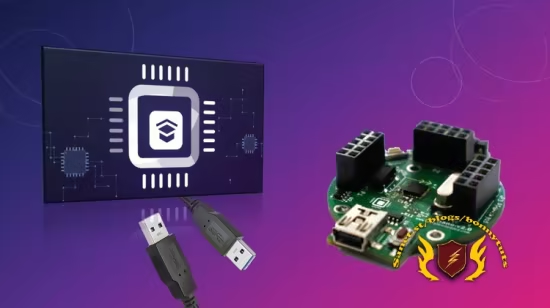
本课程基于STM32F107VCT6,通过GPIO至SPI/I2C实战,掌握传感器应用与信号处理,培养工业级嵌入式项目交付能力。
原始标题:ARM Cortex-M3 Microcontroller: Project-Based Embedded System
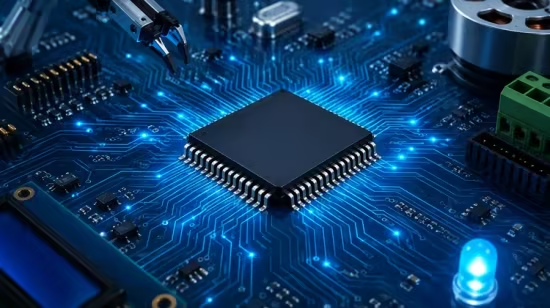
本课程基于STM32F107VCT6芯片,采用“多外设联动与信号转换”的工程导向模式,突破传统的“重理论、轻实践”教学模式,旨在通过从GPIO到SPI/I2C的实战训练,助力学员快速掌握微控制器硬件交互与核心外设驱动。课程不仅涵盖传感器应用与信号处理,更强调通过“数据采集—计算处理—联合输出”的完整系统级链路,培养学员具备独立交付工业级嵌入式项目的能力。
为了帮您在开课前做好最充分的硬软件准备,请告知您现有的STM32开发板型号、计划使用的开发环境(如Keil MDK, STM32CubeIDE)以及C语言位运算与指针的基础,以便为您提供针对性的初始化和环境配置避坑指南。
Published 8/2026
MP4 | Video: h264, 3840×2160 | Audio: AAC, 44.1 KHz, 2 Ch
Language: English | Duration: 1h 28m | Size: 7.08 GB
Master ARM Cortex-M3 with Practical STM32 Projects, Peripheral Interfacing, Sensors, SPI, I2C, ADC & DAC
What you’ll learn
Understand the fundamentals of ARM Cortex-M3 microcontrollers and the STM32F107VCT6, including GPIO and essential peripheral concepts.
Develop practical GPIO-based applications using digital inputs, outputs, buttons, LEDs, and event-driven logic.
Interface keypads, matrix keyboards, seven-segment displays, and LCDs with an ARM microcontroller to build practical embedded projects.
Implement SPI communication and use serial-to-parallel devices such as shift registers for efficient hardware interfacing.
Requirements
You do not need to be an ARM expert before starting this course. Basic programming and electronics knowledge is sufficient to begin learning and developing practical ARM microcontroller projects.
Description
“This course contains the use of artificial intelligence.”
Welcome to theARM Cortex-M3 Microcontroller Project Book Course, a practical, project-oriented course designed to help you understand ARM-based embedded-system development using theSTM32F107VCT6 microcontroller.
This course takes you beyond basic microcontroller theory and focuses onpractical peripheral interfacing and project development. You will learn how different microcontroller peripherals communicate with external hardware and how these individual building blocks can be combined to create complete embedded applications.
Throughout the course, you will exploreGPIO, digital inputs and outputs, buttons, LEDs, keypad and matrix scanning, seven-segment displays, LCD interfacing, SPI communication, I2C communication, sensor interfacing, ADC, DAC, timing, and waveform generation.
You will also work with practical examples such asdigital event handling, calculator interfaces, sensor-based temperature and humidity measurement, serial-to-parallel interfacing, and DAC-based waveform generation.
The course explains how raw hardware signals can be transformed into useful application data. For example, you will learn how an I2C sensor can provide digital measurement data, how that data can be converted into meaningful engineering values, and how the results can be displayed to the user.
You will also understand how theDAC bridges the digital and analog worlds by converting numerical values generated by the ARM microcontroller into analog voltage levels. Practical waveform-generation concepts such assquare waves, sawtooth waves, and sine waves are explored along with the importance of timing, sampling, and computational requirements.
A major focus of this course is understanding the relationship betweenhardware, software, communication protocols, data processing, and real-world outputs. Rather than studying each peripheral separately, you will see how multiple peripherals can be integrated to develop practical embedded-system solutions.
What makes this course valuable?
This is ahands-on, project-based learning experience for learners who want to understand how ARM microcontrollers are actually used in embedded applications. The course is suitable for engineering students, electronics and embedded-system learners, hobbyists, beginners with basic electronics knowledge, and professionals looking to strengthen their ARM microcontroller skills.
By the end of the course, you will have a stronger understanding of how to approach an embedded project from the initial hardware interface throughinput acquisition, processing, communication, decision-making, and final output.
Learn ARM Cortex-M3. Understand STM32 peripherals. Build practical projects. Develop real embedded-system skills.
Who this course is for
This course is especially suitable for learners who want to move beyond microcontroller theory and learn how different peripherals can be combined to develop practical embedded-system projects.
此处内容需要权限查看
会员免费查看