本课程由Laurentiu Raducu主讲,基于Claude Agent SDK,通过网上书店客服工单系统项目,手把手教你Python AI智能体与多智能体系统的生产级架构,涵盖循环、工具、工作流、记忆、护栏与评估,助你避开落地陷阱。
原始标题:Agentic Architecture: AI Agent Design Patterns in Python
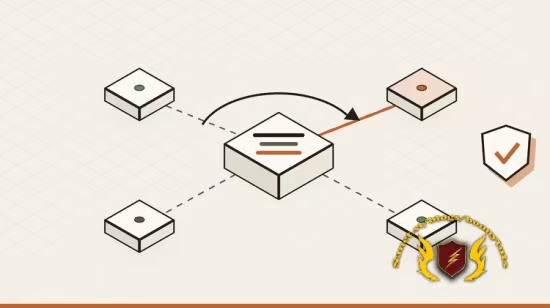
这是由 Laurentiu Raducu 于 2026年10月 推出的 基于 Claude 的 AI Agent(智能体)与多智能体系统生产级架构课程。该课程非常精炼,时长为 1小时41分钟(共 35 节课,每节课 2-4 分钟),大小为 784.3 MB,适合有 Python 基础、希望将 AI Agent 真正落地到生产环境的开发者和架构师。
这门课程的核心价值在于拒绝“PPT 演示”,完全聚焦于解决 AI Agent 在实际落地时“容易崩溃、不可控、成本高”的痛点。它基于最新的 Claude Agent SDK (Python 0.2.164) 录制,通过构建一个“网上书店客户支持工单系统”的完整项目,带你手把手攻克 AI 智能体的核心架构。
Published 10/2026
Created by Laurentiu Raducu
MP4 | Video: h264, 1920×1080 | Audio: AAC, 44.1 KHz, 2 Ch
Level: All Levels | Genre: eLearning | Language: English | Duration: 35 Lectures ( 1h 41m ) | Size: 784.3 MB
Loops, tools, workflows, multi-agent systems, memory, guardrails and evals, built with Claude and shown in real runs
What you’ll learn
⚡ Decide when a problem needs a single model call, a workflow or an autonomous agent, and justify the choice with cost and risk
⚡ Build an agent loop by hand in Python, then with the Claude Agent SDK, with turn, budget and time limits
⚡ Design tools a model uses well: clear descriptions, strict schemas, errors as results, and write tools that validate in code
⚡ Implement prompt chaining, routing, parallel sectioning and voting, orchestrator-workers and evaluator-optimizer patterns
⚡ Manage context, sessions, external memory and retrieval, including what to do when an agent’s memory is out of date
⚡ Keep agents safe with least privilege, human approval, hooks, an audit trail and defences against prompt injection
⚡ Prove an agent still works with evals graded by code, traces for every run, and cost per task
Requirements
❗ Comfortable reading Python 3. No prior experience with AI agents is needed
❗ Python 3.12 or newer to run the demo project
❗ To run the demos yourself: Claude Code installed, with a Claude subscription or an Anthropic API key. Watching the course needs neither
Description
Most agent demos look impressive for five minutes and fall apart the first time a real user writes something unexpected. This course is about what comes after the demo:the architecture that makes an AI agent predictable, affordable and safe.
You build one system from start to finish: the support desk of a small online bookshop. It reads customer tickets, looks up orders, checks a refund policy and writes replies. Some tickets are simple, some need judgment, and one order hides an instruction that tries to trick the agent into issuing a refund.
What you’ll learn
✨Workflows vs agents: who decides the next step, and how to choose the simplest shape that works.
✨The agent loop: built by hand in about thirty lines of Python, then with the Claude Agent SDK, with turn, budget and time limits that really fire.
✨Tool design: descriptions a model can use, strict schemas, errors as results, and write tools that validate every call in code.
✨Workflow patterns: prompt chaining with gates, routing with structured output, parallel sectioning and voting.
✨Multi-agent patterns: orchestrator and workers, subagents with their own context, and an evaluator that grades another model’s work.
✨State and memory: the context window as working memory, sessions that resume and fork, external memory, and retrieval versus preloaded documents.
✨Guardrails: least privilege, human approval for risky actions, hooks as policy and audit trail, and prompt injection through tool results.
✨Evaluation and operations: eval suites graded by code, traces for every run, cost per task, and the failure modes to design around.
Real runs, not slides. Every pattern is a small Python program, and every run in the videos was recorded as it happened: each model call, each tool call, each result, and what it cost. Nineteen runs in total, for seventy-one cents at API prices. When a run went wrong, you see that too: an orchestrator inventing facts because its workers lacked context, a subagent searching ten times for something that isn’t there, an evaluator that was stricter than the policy, and a memory that overruled what the customer just said. Each failure comes with the design rule that fixes it.
Recorded with the Claude Agent SDK 0.2.164 for Python, October 2026. About 1 hour 40 minutes in 35 lectures of two to four minutes, each with a short recap and many with a quick question.
Who this course is for
⭐ Software developers who want to build AI agents that behave predictably in production, not just in a demo
⭐ Tech leads and architects choosing between single calls, workflows and agents for real products
⭐ Engineers who already call LLM APIs and want patterns for tools, multi-agent systems, guardrails and evals
⭐ Anyone who wants to see what agents really do: real recorded runs with every tool call and its cost, instead of slides
此处内容需要权限查看
会员免费查看