本教程带你用Godot 4和C#从零构建祖玛式大理石射击游戏,涵盖工程规范、链条控制、碰撞插值及依赖倒置解耦,助你掌握节点系统与高级编程。
原始标题:Create a Marble Shooter Game (Zuma style) in Godot using C#
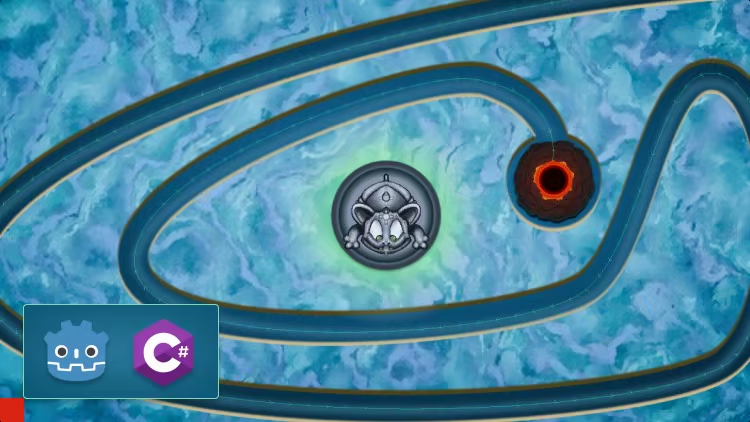
本套方案以经典Zuma的核心玩法为载体,带你从零构建一套结构清晰、面向对象且可扩展的完整游戏系统,涵盖Godot 4的.NET项目工程规范、动态大理石传送链条控制以及碰撞检测与高精度插值算法。最后通过依赖倒置原则对底层C#事件、界面框架及全局音频状态机进行系统级解耦封装,彻底掌握Godot 4节点系统与C#高级进阶编程的工程规范。你可以通过补充Godot精确版本、数据结构偏好或索取第一阶段核心源码,来让这份方案更好地配合你的实际开发。
Published 9/2026
MP4 | Video: h264, 1920×1080 | Audio: AAC, 44.1 KHz, 2 Ch
Language: English | Duration: 6h 19m | Size: 4.18 GB
Master Zuma-style marble shooter development in Godot 4 & C# through a step-by-step plan
What you’ll learn
Create a Marble Shooting game using Godot and C#
Learn new coding principles and techniques
Learn how to navigate and organize folder structure
Learn how to build levels
Learn how to manage audio
Learn to use godot node system
Learn to build and connect UI elements
Get more familiar using the game engine
Requirements
Basic knowledge of C#
Basic knowledge of Godot4+
Basic knowledge of VS Code
Basic knowledge of navigating the Windows operating system
Description
Build a Complete Zuma-Style Marble Shooter with Godot & C#
Stop watching tutorials. Start building games.
If you already know some C# and have spent time exploring Godot, the next step isn’t another course explaining what a variable or loop is.
The next step is to build something.
This course is a hands-on game development project where you’ll take an idea from concept to a complete, playable Zuma-style marble shooter using Godot and C#.
You’ll build the mechanics, solve the problems, connect the systems, debug your mistakes, and gradually turn individual pieces of code into a functioning game.
And that’s where things start getting interesting.
Build. Break. Fix. Improve.
Game development is rarely about writing code that works perfectly on the first attempt.
You build something.
It breaks.
You figure out why.
You change your approach.
Then you make it better.
This course is designed around that process.
Instead of throwing a finished project at you and asking you to copy it, you’ll be challenged to think about how each system should work before implementing it.
You’ll learn not only what to build, but how to approach the problems that appear when you’re building it.
Your Project
The goal is to create a complete marble-shooter game inspired by classics like Zuma.
You’ll have a chain of colored marbles moving through a level, a player-controlled shooter, matching mechanics, scoring, progression, and the systems necessary to turn all of it into an actual game.
Along the way, you’ll work with Godot’s scene and node architecture while writing the gameplay logic in C#.
You’ll build systems for
– Player input and aiming
– Shooting and spawning marbles
– Moving a chain of marbles along a path
– Detecting collisions and insertion points
– Managing groups of dynamically moving objects
– Detecting matching colors
– Removing groups of three or more marbles
– Handling chain reactions and gaps
– Calculating and displaying scores
– Managing game states
– Creating UI and player feedback
– Building levels and progression
– Structuring reusable C# game systems
Each mechanic becomes another piece of the puzzle.
Eventually, those pieces come together into a complete game.
This Is a Project-Based Course
You’re not going to spend the entire course sitting through lectures about programming concepts and hoping you’ll remember them later.
You’ll use what you learn immediately.
When you learn about collections, you’ll have a reason to use them.
When you work with C# classes, they’ll exist because your game needs them.
When you encounter object management, collisions, or game state, you’ll be solving an actual problem inside your project.
That’s the difference between simply learning a programming concept and understanding why and when to use it.
Challenge Yourself First
One of the most important parts of the course is the challenge.
Before showing you how a particular system works, you’ll have the opportunity to think about how you would solve it yourself.
You might get it right.
You might get it completely wrong.
Either way, you’re learning.
Then we’ll break down the solution and build it step by step.
After that, you’ll have opportunities to apply the same concepts again in different situations.
The objective isn’t to make you good at following instructions.
It’s to make you better at solving problems.
What You’ll Learn Along the Way
By building this game, you’ll gain practical experience with areas of Godot and C# that show up again and again in real game projects.
You’ll become more comfortable working with
– Godot scenes and nodes
– C# scripts
– Game objects and references
– Collections and data structures
– Signals and events
– Player input
– Collision detection
– Movement systems
– Object spawning and management
– Game states
– UI systems
– Reusable gameplay components
– Debugging and problem solving
These aren’t skills that only apply to a marble shooter.
They’re building blocks you can carry into your next game.
Who Is This Course For?
This course is aimed at developers who already have some familiarity with C# and Godot and want to put those skills into practice.
It’s a great fit if you
Want to move beyond small programming exercises
Learn best by building real projects
Want more experience with Godot’s architecture
Want to use C# for actual gameplay programming
Enjoy puzzle and arcade games
Want to understand how individual mechanics become a complete game
Are looking for a project you can expand after finishing the course
You don’t need to be an expert.
You just need to be willing to build, experiment, make mistakes, and keep going.
More Than One Finished Game
When you finish the course, you’ll have a complete marble shooter you can play and continue developing.
But the real value is what happens while you’re building it.
You’ll learn how to look at a game mechanic and break it into smaller problems.
You’ll become more comfortable reading errors and debugging your own code.
You’ll start recognizing patterns that can be reused in other projects.
And you’ll develop something every game developer needs: the confidence to figure things out.
Because eventually, every developer reaches a point where the tutorial ends.
There is no next video.
There is no step-by-step instruction.
There’s just a problem in front of you.
The goal of this course is to help you become the developer who says
“Alright. Let’s figure it out.”
What You’ll Get
The course is designed around a practical, project-first learning experience.
You’ll receive
– Step-by-step development lessons
– Complete project files
– C# scripts used throughout the project
– Supporting resources and references
– Practical examples of debugging and problem solving
You can follow along, experiment with the systems, break things, rebuild them, and ultimately make the project your own.
What This Course Doesn’t Focus On
The goal is to teach you game development and programming, not every discipline involved in producing a commercial game.
We won’t be focusing heavily on
– Creating professional art assets from scratch
– Complex shader development
– Deep engine-level optimization
– Building custom editor extensions
– Modifying the underlying physics engine
The focus stays where it matters for this project: building gameplay systems with Godot and C#.
And Then?
Once you’ve built the marble shooter, you don’t have to stop.
Change the rules.
Add new levels.
Create power-ups.
Introduce different ball types.
Add new obstacles.
Change the scoring system.
Build a completely different game using the same underlying ideas.
Build a completely different UI, that matches your mood.
That’s the advantage of learning through projects.
You’re not just collecting information.
You’re building a foundation.
If you’re ready to take your Godot and C# skills out of the tutorial phase and put them to work on a real game, this is your next challenge.
Open Godot. Start building. Let’s see what you can create!
Who this course is for
Students and professionals who have basic experience making games in Godot and using C#, and who want to learn something new and build on their existing knowledge.
百度网盘下载: