本课程系统讲解VLSI可测性设计,覆盖扫描链、故障建模、ATPG与BIST等核心技术,帮助初学者掌握提升芯片测试覆盖率与降低测试成本的工业级DFT工作流。
原始标题:VLSI Testing & Design for Testability (DFT): Complete Course
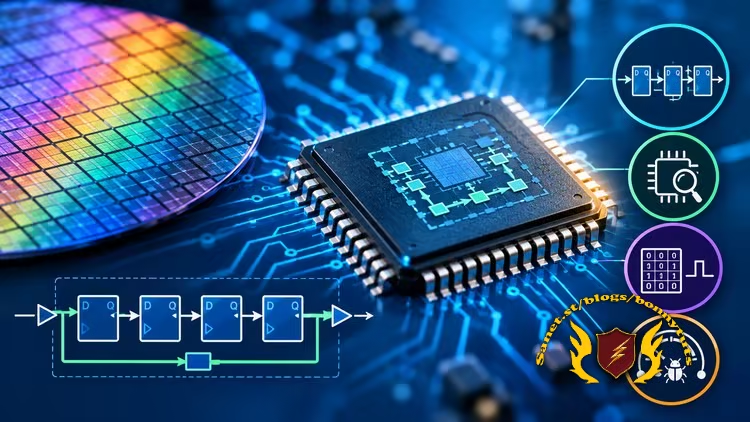
本课程是一门针对数字集成电路可测性设计(DFT)的零基础系统级指南。在长达 19.5 小时的教学中,它紧密围绕现代半导体制造中的缺陷检测核心,深入浅出地讲解了扫描链架构(Scan Chain)、故障建模(Fault Modeling)、自动测试向量生成(ATPG)以及内建自测试(BIST)等工业界核心 DFT 技术。课程不仅帮助学习者理解如何通过改进电路结构来大幅提升微芯片的测试覆盖率、降低测试成本,还系统性地梳理了标准 DFT 工作流与常见设计挑战,非常适合具备基础数字逻辑知识、渴望进入晶圆制造与芯片设计领域的高级测试或 DFT 岗位初学者。
Published 10/2026
Created by chethan DC
MP4 | Video: h264, 1920×1080 | Audio: AAC, 44.1 KHz, 2 Ch
Level: Beginner | Genre: eLearning | Language: English | Duration: 14 Lectures ( 19h 40m ) | Size: 10.2 GB
Learn VLSI Testing, Fault Simulation, ATPG, Sequential Circuit Testing, Memory Testing and Built-In Self-Test (BIST).
Learn VLSI Testing, Fault Simulation, ATPG, Sequential Circuit Testing, Memory Testing and Built-In Self-Test (BIST).
What you’ll learn
⚡ Understand the fundamentals of VLSI Design for Test (DFT) and why testability is essential in modern semiconductor design.
⚡ Learn scan chain architecture, scan flip-flops, scan insertion concepts, and test modes used in digital IC testing.
⚡ Understand Built-In Self-Test (BIST), fault models, test pattern generation, and fault coverage fundamentals.
⚡ Explore the DFT workflow, common testing challenges, and industry practices used to improve digital chip testability.
Requirements
❗ Basic knowledge of digital electronics and logic gates is helpful.
❗ Familiarity with flip-flops, multiplexers, and sequential circuits is recommended.
❗ Basic understanding of VLSI design is an advantage but not mandatory.
❗ No prior industry experience or paid software tools are required to learn the fundamentals.
Description
VLSI Testing & Design for Testability (DFT): Complete Course
Learn the fundamentals ofVLSI Testing, Design for Testability (DFT), Fault Modeling, and Automatic Test Pattern Generation (ATPG) in this comprehensive course designed for electronics students, VLSI beginners, and aspiring semiconductor testing engineers.
As integrated circuits become increasingly complex, effective testing is essential for identifying manufacturing defects, improving product quality, and ensuring reliable chip operation. This course introduces the fundamental concepts and techniques used in digital circuit testing, sequential circuit testing, memory testing, and mixed-signal testing.
What You Will Learn
By the end of this course, you will understand
✨ The fundamentals and importance of VLSI testing.
✨ Fault modeling, fault equivalence, and fault collapsing.
✨ Logic simulation and fault simulation techniques.
✨ Testability measures, including controllability and observability.
✨ Automatic Test Pattern Generation (ATPG) fundamentals.
✨ Test pattern generation for combinational circuits.
✨ Testing techniques and challenges for sequential circuits.
✨ Memory testing concepts and fault detection.
✨ Built-In Self-Test (BIST) principles and applications.
✨ Delay testing and timing-related faults.
✨ Analog and mixed-signal testing fundamentals.
✨ Fault-tolerant VLSI design concepts.
Course Curriculum
1. Introduction to VLSI Testing
Understand the objectives of integrated circuit testing and its role in semiconductor manufacturing.
2. Fault Modeling
Explore fault models used to represent circuit defects and support systematic fault detection.
3. Fault Collapsing
Learn about fault equivalence, fault dominance, and reducing the number of faults considered during testing.
4. Logic Simulation
Understand how logic simulation helps analyze digital circuit behavior.
5. Fault Simulation
Explore fault simulation and its role in evaluating test patterns and fault coverage.
6. Testability Measures
Learn how controllability and observability influence circuit testability.
7. Introduction to ATPG
Discover the fundamentals of Automatic Test Pattern Generation and how test patterns are created to detect faults.
8. ATPG for Combinational Circuits
Study the principles of generating test patterns for combinational logic circuits.
9. Testing of Sequential Circuits
Understand the challenges of testing circuits containing flip-flops, registers, and sequential logic.
10. Memory Testing
Explore memory testing fundamentals and techniques for identifying memory faults.
11. Built-In Self-Test (BIST)
Learn the principles of incorporating test capabilities into integrated circuits.
12. Analog and Mixed-Signal Testing
Discover the fundamental challenges of testing analog and mixed-signal integrated circuits.
13. Delay Testing
Understand delay faults and the importance of timing-related testing.
14. Fault-Tolerant VLSI Design
Explore concepts used to improve system reliability in the presence of hardware faults.
Who Should Enroll?
✨ Electronics and Communication Engineering (ECE) students.
✨ Electrical and Electronics Engineering (EEE) students.
✨ Undergraduate and postgraduate VLSI students.
✨ Beginners interested in semiconductor testing and DFT.
✨ Aspiring VLSI testing, validation, and DFT engineers.
✨ Students looking to strengthen their understanding of VLSI testing concepts.
Why Learn VLSI Testing and DFT?
VLSI testing is an important part of semiconductor design and manufacturing. Understanding fault models, fault simulation, ATPG, memory testing, and BIST provides a strong foundation for further learning in Design for Testability and semiconductor test engineering.
This course offers a structured introduction to essential VLSI testing concepts, helping you build your technical knowledge and prepare for more advanced topics in the semiconductor industry.
Enroll today and strengthen your foundation in VLSI Testing, DFT, ATPG, and semiconductor testing!
Who this course is for
⭐ Electronics and Electrical Engineering students interested in VLSI and semiconductor careers.
⭐ Beginners who want to understand Design for Testability (DFT) concepts.
⭐ Fresh graduates preparing for entry-level VLSI DFT engineer roles and interviews.
⭐ RTL designers and verification engineers who want to expand their knowledge of scan testing, BIST, fault models, and test methodologies.
⭐ Professionals seeking a foundation in digital IC testing and testability.
百度网盘下载: