本课程通过智能设备健康监测仪案例,教你超越Arduino拼凑式开发,掌握MCU选型、非阻塞固件、AI安全验证与工业级故障调试,建立可复用的嵌入式工程方法论,将原型蜕变为可量产的真实产品。
原始标题:From Arduino Projects to Embedded Systems Engineering
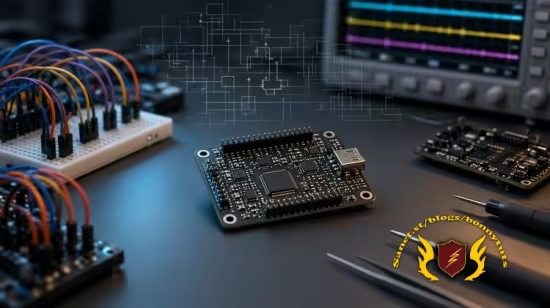
该课程(Embedded System Design & Product Engineering)是一门面向中级学员的、长达 6 小时 2 分钟 的嵌入式系统设计与产品工程进阶课。由 Educational Engineering Team 打造,课程通过围绕一个“智能设备健康监测仪(Smart Equipment Health Monitor)”的贯穿式案例,专注于教导学员如何超越日常的 Arduino 式拼凑代码,真正以总揽全局的工程师思维,做出严谨、可靠的硬件选型与架构决策。
课程不仅涵盖需求拆解、MCU 评估、响应式非阻塞固件设计等核心架构技术,更前沿地引入了生成式 AI 在嵌入式开发中的安全验证工作流,并深度聚焦于看门狗复位、掉电(Brownout)故障、通信死锁等复杂工业级故障的系统化调试与恢复策略。学员最终将掌握如何将一个不稳定的实验板原型,蜕变为具备可测试性、可制造性、支持固件回滚及量产准备的真实产品,建立起一套独立于任何特定单片机型号或开发环境的、可复用的嵌入式工程方法论。
Published 9/2026
Created by Educational Engineering Team
MP4 | Video: h264, 1920×1080 | Audio: AAC, 44.1 KHz, 2 Ch
Level: Intermediate | Genre: eLearning | Language: English | Duration: 62 Lectures ( 6h 2m ) | Size: 1.7 GB
Choose MCUs, architect reliable firmware, use AI safely, debug failures, and turn prototypes into products.
What you’ll learn
⚡ Translate vague embedded project ideas into measurable functional requirements, non-functional requirements, constraints, and verification criteria.
⚡ Design a first-pass embedded system architecture before writing code and identify critical paths, dependencies, failure boundaries, and hardware/software respon
⚡ Select microcontrollers using compute performance, Flash, RAM, peripherals, power, connectivity, tooling, cost, lifecycle, and resource margin.
⚡ Design responsive and maintainable firmware using non-blocking execution, polling, interrupts, state machines, modular architecture, scheduling, and justified R
⚡ Use AI to analyze datasheets, review code, compare hardware, generate tests, and explore alternatives while verifying important claims against authoritative evi
⚡ Debug embedded systems systematically using logs, measurements, fault isolation, hypothesis testing, oscilloscopes, logic analysis, reset evidence, and controll
⚡ Design explicit recovery strategies for communication failures, watchdog resets, brownouts, sensor faults, race conditions, and degraded operation.
⚡ Evaluate whether an embedded prototype is ready to become a product using reliability, testability, manufacturing, serviceability, configuration, calibration, u
⚡ Build structured engineering review artifacts such as MCU-selection scorecards, firmware-architecture reviews, debugging incident reports, and production-readin
⚡ Develop a reusable embedded-engineering decision process that is independent of one board, MCU family, framework, or AI platform.
Requirements
❗ Basic experience writing embedded C/C++ or Arduino-style microcontroller code.
❗ Familiarity with at least one microcontroller platform such as Arduino, ESP32, STM32, PIC, Raspberry Pi Pico, or a similar MCU.
❗ Basic electronics knowledge including voltage, digital and analog I/O, sensors, and common communication interfaces.
❗ No previous RTOS, professional firmware architecture, AI engineering workflow, or productization experience is required.
❗ No specific hardware is required to follow the conceptual lessons, although access to a microcontroller board and basic test equipment is useful for applying the techniques independently.
Description
This course contains the use of artificial intelligence.
Moving from an Arduino project that works to a professionally designed embedded system requires much more than writing code.
Professional embedded development requires engineers to define measurable requirements, make architecture decisions, select hardware using evidence, manage timing and memory constraints, design maintainable firmware, verify AI-generated recommendations, diagnose failures systematically, and think beyond the prototype toward reliability and product readiness.
This course teaches that transition.
Instead of focusing on another collection of board-specific projects, libraries, or syntax examples, we will work through the engineering decisions that determine whether an embedded system remains reliable as its complexity grows.
A recurring Smart Equipment Health Monitor case study connects the course from beginning to end. You will see how the same system evolves from an initial product idea into requirements, architecture, MCU selection, firmware design, failure handling, AI-assisted engineering workflows, debugging strategies, and finally a production-readiness review.
You will learn how to translate vague project ideas into testable requirements and constraints, choose microcontrollers using compute, memory, peripheral, power, tooling, and lifecycle considerations, and design firmware using bounded execution, state machines, modular responsibilities, interrupts, scheduling, and RTOS concepts when they are actually justified.
You will also learn how to use AI as an engineering copilot rather than treating generated answers as engineering evidence. The course demonstrates practical verification workflows for datasheets, generated code, hardware recommendations, timing claims, electrical limits, debugging hypotheses, and test generation.
The debugging sections focus on evidence-driven diagnosis across firmware and hardware boundaries, including power and brownout problems, communication failures, race conditions, watchdog recovery, invalid sensor data, and field-like failures.
Finally, you will move beyond the working prototype and examine reliability, testability, manufacturing and service access, configuration and calibration control, firmware updates, rollback strategies, diagnostics, engineering handoff, and production-readiness decisions.
This course is designed for learners who can already build embedded projects but want to develop the engineering judgment required to design systems that are easier to verify, debug, maintain, extend, and eventually turn into real products.
Throughout the course, you will work with engineering scenarios, decision challenges, architecture reviews, debugging cases, verification exercises, section assessments, and a final capstone workflow.
By the end, you will have a repeatable engineering process that you can apply beyond one development board, microcontroller family, framework, or AI tool.
Who this course is for
⭐ Arduino, ESP32, STM32, PIC, Raspberry Pi Pico, and other microcontroller learners who can already build projects but want to think more like embedded engineers.
⭐ Electronics, electrical, computer, and mechatronics engineering students who want practical embedded-system design skills beyond basic programming.
⭐ Junior embedded developers who want stronger architecture, debugging, verification, and product-engineering judgment.
⭐ Makers and technical developers moving from prototypes and hobby-style projects toward more maintainable and reliable embedded systems.
⭐ Engineers interested in using AI effectively in embedded development without blindly trusting generated code or technical claims.
此处内容需要权限查看
会员免费查看