本课程讲解如何用 SQL Server 2025、AdventureWorks 与 OpenAI 构建企业级 RAG 架构,掌握 VECTOR 类型、DiskANN 索引、权限感知检索与 T-SQL 一体化审计。
原始标题:Build Enterprise RAG with OpenAI & SQL Server 2025
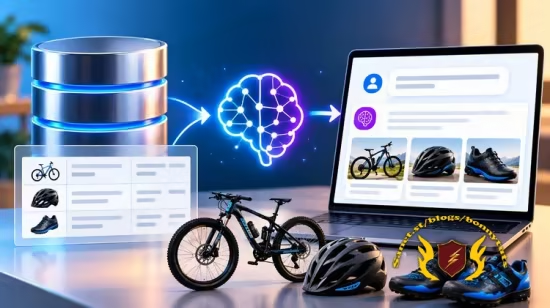
本课程旨在通过 SQL Server 2025、AdventureWorks 业务数据与 OpenAI 的深度整合,打造企业级的原生数据库 RAG(检索增强生成)架构。学员将掌握如何配置数据库外发 REST API 安全通信,使用主密钥加密存储 AI 凭据,并利用全新的 VECTOR 数据类型与 DiskANN 向量索引,在 SQL Server 内部高效实现海量数据的批量向量化、存储与语义相似度检索。
课程的核心价值在于解决 AI 落地中的安全与数据一致性痛点,实现权限感知(Authorization-Aware)的向量检索与全流程审计。通过纯 T-SQL 编写的单一体化存储过程,系统能在检索阶段前置过滤未授权业务信息,将向量结果与 live 关系型数据(如价格、库存)完美融合并构建精准的提示词(Grounding),最终直接在 SQL Server Management Studio (SSMS) 中安全地外发 OpenAI 生成答案,并自动建立包含执行身份与时间戳的完整 AI 审计轨迹。
Published 10/2026
Created by Bluelime Learning Solutions
MP4 | Video: h264, 1280×720 | Audio: AAC, 44.1 KHz, 2 Ch
Level: Beginner | Genre: eLearning | Language: English | Duration: 37 Lectures ( 2h 57m ) | Size: 1.2 GB
Build Vector Search, DiskANN, Authorization, Grounding & Auditing with T-SQL and OpenAI
What you’ll learn
⚡ Design an enterprise-style RAG architecture using SQL Server 2025, AdventureWorks business data, and OpenAI.
⚡ Configure SQL Server 2025 for secure outbound REST API communication with external AI services.
⚡ Securely store OpenAI API credentials inside SQL Server using a database master key and database-scoped credentials.
⚡ Create native vector-enabled tables in SQL Server 2025 using the VECTOR data type
⚡ Transform relational AdventureWorks product data into an AI-ready vector store using T-SQL.
⚡ Call the OpenAI Embeddings API directly from SQL Server
⚡ Build a reusable T-SQL stored procedure that converts natural-language text into vector embeddings using OpenAI.
⚡ Batch-vectorize existing SQL Server records and persist their embeddings using native vector storage.
⚡ Create and configure a DiskANN vector index to support efficient semantic similarity searches in SQL Server 2025.
⚡ Perform semantic vector searches from natural-language user intent instead of relying solely on exact keyword matching.
⚡ Implement authorization-aware vector retrieval so unauthorized business information is excluded before becoming AI grounded context.
⚡ Combine vector search results with live relational business data, such as product information and pricing.
⚡ Build grounded prompts dynamically with T-SQL using information retrieved from SQL Server.
⚡ Create a complete authorization-aware RAG stored procedure that orchestrates embeddings, retrieval, grounding, auditing, and OpenAI generation.
⚡ Send grounded business context directly from SQL Server to OpenAI and return natural-language AI responses.
⚡ Create an AI audit trail in SQL Server to record user queries, execution identity, retrieval activity, and timestamps.
⚡ Run natural-language intent queries directly from SQL Server Management Studio and retrieve AI-generated answers grounded in AdventureWorks data.
⚡ Evaluate semantic-search results and distinguish similarity from factual equivalence, helping prevent unsupported AI conclusions.
⚡ Apply monitoring, auditing, authorization, and grounding principles when designing more robust enterprise AI solutions.
⚡ Identify real-world RAG production considerations including hallucinations, source-data quality, prompt design, API latency, cost, security, and governance.
Description
Build an enterprise-style Retrieval Augmented Generation solution using SQL Server 2025, native vector search, T-SQL, and OpenAI.
Generative AI is transforming how users interact with business data. But what if you could bring modern AI capabilities directly into SQL Server and allow users to ask natural-language questions that are answered using information retrieved from your own database?
In this hands-on, project-based course, you will build a completeRAG application from the ground up using SQL Server 2025 and the AdventureWorks database.
You’ll begin by understandingRetrieval Augmented Generation, embeddings, semantic search, and vector databases. You’ll then configure SQL Server to communicate securely with OpenAI and learn how to protect API credentials using database security features.
Next, you’ll create a dedicated AI vector store using SQL Server 2025’s nativeVECTOR data type. You’ll transform AdventureWorks product information into vector embeddings using OpenAI and store those embeddings directly inside SQL Server.
You’ll then create aDiskANN vector index and use semantic vector search to retrieve products based on meaning and user intent rather than relying solely on exact keyword matches.
But this course goes beyond a basic RAG demonstration.
You’ll implementauthorization-aware retrieval, ensuring that only permitted information can become part of the context supplied to the AI model. You’ll combine vector results with live relational business data, build grounded prompts dynamically with T-SQL, and create anAI audit log for monitoring queries and retrieval activity.
Finally, you’ll bring everything together in a complete RAG stored procedure that accepts a natural-language question, generates an embedding, performs semantic retrieval, applies authorization, builds grounded context, calls OpenAI, and returns a natural-language response.
You’ll also explore important real-world considerations includinghallucinations, data quality, prompt design, vector-search trade-offs, security, governance, API costs, embedding freshness, auditing, and SQL Server vector caveats.
By the end of the course, you’ll have built a practical end-to-end AI project demonstrating howSQL Server 2025, T-SQL, native vectors, DiskANN, and OpenAI can work together to create modern, enterprise-style RAG applications.
Who this course is for
⭐ QL Server developers and database professionals who want to add Generative AI, RAG, embeddings, and vector search to their existing SQL Server skills.
⭐ QL developers and T-SQL programmers who want to build AI-powered applications directly with SQL Server rather than relying entirely on Python or external AI frameworks.
⭐ Database administrators and SQL Server professionals interested in the new AI and native vector capabilities available in SQL Server 2025.
⭐ Data engineers who want practical experience combining relational business data, vector embeddings, semantic search, and Generative AI.
⭐ AI and Generative AI learners who want to understand how RAG can be implemented using enterprise relational databases and real business data.
⭐ Software developers and application developers who want to integrate OpenAI with SQL Server and build natural-language interfaces over structured business data.
⭐ Data analysts and BI professionals who want to expand their skills into AI, semantic search, vector databases, and RAG applications.
⭐ Solution architects and technical consultants who want to understand how SQL Server, vector search, authorization, governance, and OpenAI can work together in an enterprise-style RAG architecture.
⭐ Students and aspiring AI or data professionals looking for a practical portfolio project that demonstrates SQL, vector search, OpenAI integration, and RAG skills.
⭐ Professionals preparing for AI-focused database and data-engineering roles who want hands-on exposure to modern AI capabilities within the Microsoft SQL Server ecosystem.
⭐ Anyone interested in building RAG solutions without LangChain or a separate vector database, using SQL Server 2025 native vectors and T-SQL instead.
⭐ Curious beginners with basic SQL knowledge who want a guided, step-by-step introduction to embeddings, semantic vector search, grounding, authorization-aware retrieval, auditing, and Retrieval Augmented Generation.
此处内容需要权限查看
会员免费查看