
卡尔·里普圣三一管风琴音色库
21.3GB Hauptwerk音源,收录奥托博伊伦修道院仅存的卡尔·约瑟夫·里普管风琴,融合法德风琴传统,音色温暖饱满,珍贵原声再现。适合专业管风琴采样与音乐制作。
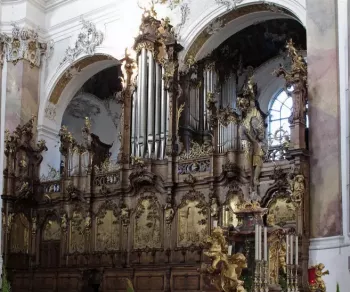
Hauptwerk | 21.3 GB
The smaller Holy Ghost organ and the large Holy Trinity organ of the Benedictine Abbey of Ottobeuren/Unterallgäu, founded in 764, are the only surviving instruments built by Karl Joseph Riepp and are both almost completely original. Due to their construction, quality craftsmanship and especially unique architecture and sound, they are an extremely important part of our international organ heritage.
They combine French and Southern German sound ideals and can be regarded as timeless organ treasures. The Rococo Holy Ghost organ is more Southern German orientated, while the large Holy Trinity organ has a more typical French character.
Riepp’s organ building style is characterized by numerous warm and full sounding foundation stops, partially lower pitched mixtures, powerful reeds with full resonator lengths, aliquots and cornets with wide scales and beautiful flutes. Exceptional is how well all the stops blend together.
“No verbal description could ever convey the perfection of Ottobeuren Trinity organ, a fine flower sown in France, but cultivated in Germany,
its sensual splendour, ranging from reeds and mutations solos of excellent piquancy to perhaps the best Organo Pleno of its period” (Peter Williams, “The European organ, 1450-1850”).
The Rococo basilica sanctuary has a reverberation time up to 6 seconds.
Recording Technique
The organ was recorded in Okt. 2012/Jan. 2013 with 48 kHz, 24 bit, multi-channel, using the multi-release technique introduced by OrganArt. All stops were recorded with multiple release levels for short, medium and long key attacks for optimal acoustical mapping. Additionally recorded were up to three native tremulant sounds (no simulation!)
The set supports 4-channel (Surround and/or Variable Audio Perspective VAP).
Specification
II: Hauptwerk (C–d3)*
01. Copel 16
02. Princip 8
03. Copel 8
04. Flauta 8
05. Gamba 8
06. Salicet 8
07. Prestant 4
08. Flet 4
09. Tertz 3
10. Quint 3
11. Waldflet 2
12. Tertz 1 1/2
13. Cornet (5f, from c1)
14. Mixtur (4f, 2 2/3′)
15. Cimbal (4-6f, 1′)
16. Trompet 8
17. Clairon 4
I: Brüstungs-Positiv (C-f#, g–d3)*
01. Princip 16 D
02. Copel 8 B/D
03. Flauta 8 B/D
04. Octav 4
05. Flet 4
06. Gamba 4 B/D
07. Nazard 3 B/D
08. Quart 2 B/D
09. Tertz 1 1/2 B/D
10. Quint 1 1/2 B/D
11. Fornit (5-6f, 1′) B/D
12. Trompet 8 B/D
13. Cromor 8 B/D
14. Voxho 8 B/D
15. Clairon 4 B/D
III: Récit (C-f#, g–d3)*
01. Cornet Resi (5f, from g)
02. Copel 8 B +
03. Flet 4 B +
04. Quint 3 B +
05. Quart 2 B +
06. Tertz 1 1/2 B +
07. Hoboi 8 B +
IV: Echo (C-e, f–d3)*
01. Copel 8 B/D
02. Flet 4 B/D
03. Quint 3 B
04. Quart 2 B
05. Tertz 1 1/2 B
06. Larigot (2 2/3’+2′) D
07. Tertz (1 3/5’+1′) D
08. Hoboi 8 B/D
Pedal (C-c1)*
01. Princip 16
02. Copel 16
03. Octav 8
04. Gamb 8
05. Quint 6
06. Flet 4
07. Mixtur (3f)
08. Bomba 16
09. Trompet 8
10. Trompet 4
Couplers
POS-HW (Shift Coupler)
Facilities
Tremolo I dous (medium)
Tremolo dous II, III, IV (slow)
Tremolo forte I-IV (fast)
* Switchable compass extension: Manuals C–f3, Pedal C–f1
+ Transmission bass stops from IV (C-f#), extension Cornet Resi
Pitch and Temperament
Slightly non-equal temperament, a1= 422 Hz
此处内容需要权限查看
会员免费查看