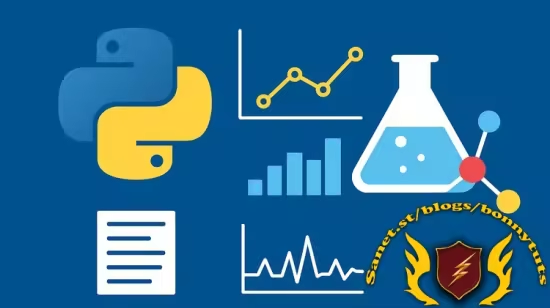
Python化学数据分析与绘图入门
掌握用Python处理化学数据的技能,从零基础学会清洗、分析光谱、热力学与动力学数据,并生成专业二维、三维及交互式图表,适合无编程与数据科学背景的化学学习者。
Published 8/2025
Created by Khurshid Ayub
MP4 | Video: h264, 1280×720 | Audio: AAC, 44.1 KHz, 2 Ch
Level: Beginner | Genre: eLearning | Language: English | Duration: 65 Lectures ( 3h 58m ) | Size: 1.8 GB
Master data handling, visualization, and real-world chemical analysis with Python—no coding or data science background n
What you’ll learn
Learn to efficiently manage, clean, and preprocess chemical datasets using Python.
Import, clean, and manipulate raw chemical data using Python libraries (pandas, numpy, etc.).
Generate professional-quality plots (2D, 3D, interactive) tailored to chemistry problems.
Analyze spectroscopic, thermodynamic, and kinetic datasets to draw research-level conclusions.
Reproduce and interpret data analyses from published chemistry research articles
Apply best practices in reproducibility, documentation, and data-driven research.
Requirements
No advanced coding knowledge is required — we start from the basics and move step by step toward professional-level chemical data analysis.
Description
Chemistry generates data at every level — from titration curves and kinetic measurements to spectroscopy outputs and thermodynamic models. Yet, many chemists struggle to efficiently analyze and visualize this data in a way that leads to clear insights and impactful communication. This course, Data Analysis & Plotting for Chemistry with Python, is designed to bridge that gap.Starting with the basics of Python, you will quickly progress to mastering essential libraries such as NumPy and Pandas, for handling and analyzing chemical datasets. You will then learn to create high-quality plots using Matplotlib ensuring your graphs are not just scientifically accurate but also publication-ready. Every concept is explained in the context of chemistry, with real datasets and case studies drawn from spectroscopy, kinetics, thermodynamics, and analytical chemistry.By the end of the course, you will be able to clean and organize experimental data, perform numerical analyses, and present your results with professional-grade visualizations. Whether you are a student preparing lab reports, a researcher analyzing experiments, or a professional aiming to improve reporting workflows, this course will give you the practical skills to transform raw chemical data into clear, meaningful insights. Moreover, this course will pave your easy way to machine learning where large datasets are handled, analyzed and interpreted.No prior coding experience is required — just curiosity and a willingness to learn.
此处内容需要权限查看
会员免费查看