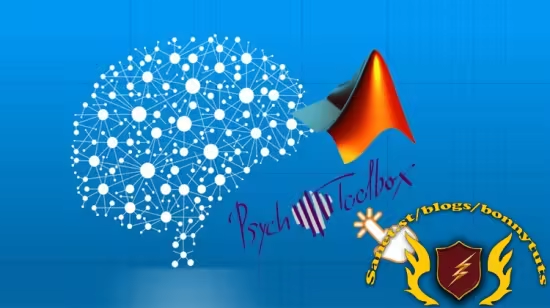
本课程专为初学者设计,由Neura Skills团队制作。通过41节5小时25分的视频,学习MATLAB基础、Psychtoolbox安装与使用,掌握呈现刺激、收集反应、记录数据等核心技能,并探索AI辅助认知任务设计。适合心理学与认知科学初学者。
原始标题:Psychtoolbox in MATLAB for Absolute Beginners
Published 4/2025
Created by Neura Skills,Neura Skills Team
MP4 | Video: h264, 1280×720 | Audio: AAC, 44.1 KHz, 2 Ch
Level: All | Genre: eLearning | Language: English | Duration: 41 Lectures ( 5h 25m ) | Size: 2.11 GB
Design and Run Your First Cognitive Task with MATLAB
What you’ll learn
What are cognitive tasks? We will learn their history, principles of mental chronometry, and the important components of task design.
Before learning how to use Psychtoolbox, we will first learn the fundamental concepts of MATLAB, including basic operations, variables, indexing, etc.
Learn Psychtoolbox from installation to building your first experiment. We will learn how to present stimuli, collect responses, and store data.
Understand how to work with images, text, and sound stimuli in Psychtoolbox.
Learn how to use keyboard input functions in Psychtoolbox, such as KbCheck and KbWait, to record participant responses.
Discover how AI-powered tools can assist in cognitive task design, from generating experimental conditions to automating aspects of script writing.
Requirements
This course is beginner-friendly and does not require prior programming experience. The only necessary software is MATLAB and Psychtoolbox. A basic computer setup with a keyboard and mouse is sufficient to follow along.
Description
This step-by-step course is designed for absolute beginners who want to learn how to program their very first cognitive task using MATLAB and Psychtoolbox. This course is ideal for students and researchers in psychology, neuroscience, and cognitive science. The course begins with an introduction to cognitive tasks, covering their history, key principles of mental chronometry, and its relevant components. You will learn the fundamentals of using MATLAB and comfortable with it, will be introduced to Psychtoolbox, learning how to install it, run demos, and build your first simple yet interesting reaction time experiment (i.e., a Facial Emotion task). You will learn how to work with visual and auditory stimuli, capturing keyboard responses, adding sound stimuli, and writing a complete task from scratch. With no prior programming experience required, this course provides a clear, structured, and beginner-friendly approach to learning cognitive task programming. A section of the course introduces briefly the concept of triggers and how to send them. You will also see how to use AI-powered tools to generate your tasks in an efficient way. All concepts are introduced gradually and practically that even those with no coding background can follow along and start building their own experiments by the end of the course.
此处内容需要权限查看
会员免费查看