学习使用Ollama、Python与Streamlit在本地构建私有AI应用,实现数据隐私安全。掌握RAG系统、JSON结构化输出与智能Agent工作流,适合全级别开发者。
原始标题:Build Local AI Apps with Ollama, Python, and Streamlit
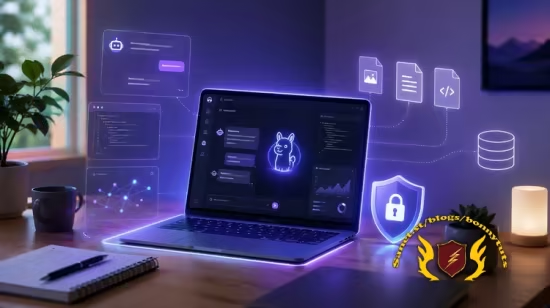
本课程核心聚焦于100%本地化与数据隐私安全,教你如何彻底摆脱对云端付费 API 的依赖,在个人电脑上利用 Ollama 顺畅运行大型语言模型,并使用 Python 语言将这些模型与实际业务逻辑进行高效连接。
在核心功能构建上,课程采用循序渐进的方式,教你通过 Streamlit 快速搭建出美观的交互界面,结合向量数据库 ChromaDB 构建本地 RAG(检索增强生成)系统,让 AI 在长对话记忆的加持下,能够精准阅读并引用你上传的私密 PDF 和文本文件。
在迈向生产环境的进阶部分,你将掌握如何让本地模型稳定输出结构化 JSON 数据,开发出能自主调用外部工具的智能 Agent(代理)工作流,并最终学会如何对本地 AI 应用进行性能评估与优化,真正实现企业级私有化 AI 项目的落地。
Published 7/2026
Created by School of AI, Arjun Vaid
MP4 | Video: h264, 3840×2160 | Audio: AAC, 44.1 KHz, 2 Ch
Level: All Levels | Genre: eLearning | Language: English | Duration: 42 Lectures ( 7h 29m ) | Size: 7 GB
Build private, production-ready AI apps locally with Ollama, Python, Streamlit, RAG, memory, tools, and real projects
What you’ll learn
⚡ Install Ollama and run large language models locally on a computer.
⚡ Connect Python applications to Ollama models.
⚡ Build interactive AI applications with Streamlit.
⚡ Create chatbots with memory, personas, and conversation history.
⚡ Process PDF and text documents for local AI workflows.
⚡ Generate embeddings and build semantic search with ChromaDB.
⚡ Create Retrieval-Augmented Generation applications with citations.
⚡ Generate structured JSON outputs, summaries, flashcards, and quizzes.
⚡ Build tool-using AI applications and research workflows.
⚡ Evaluate, optimize, and manage production-ready local AI applications.
Description
This course contains the use of artificial intelligence.
Build powerful, private, and practical AI applications directly on your own computer withOllama,Python, andStreamlit.
This hands-on course teaches you how to create completelocal AI apps without depending on paid AI APIs or sending sensitive information to external cloud services. You will learn how to runlarge language models locally, connect them to Python, design effective prompts, build interactive user interfaces, and transform simple ideas into useful AI applications.
As you progress, you will build conversational applications withchat history,memory, customizable personas, session state, conversation exports, and reset controls. You will also learn how to process PDF and text documents, clean and chunk content, generatelocal embeddings, store vectors inChromaDB, and performsemantic search across private knowledge.
Next, you will build completeRetrieval-Augmented Generation, orRAG, applications. You will retrieve relevant document sections, construct grounded prompts, generate answers with sources and page references, reduce hallucinations, and handle questions that are not supported by the available documents.
The course also coversstructured AI outputs, reusable prompt templates, JSON generation, summarization, flashcards, quizzes, progress tracking, and learning applications. You will then move intotool-using AI, where models can call Python functions, organize research tasks, compare evidence, track references, and produce structured research reports.
Every day includes a practical, industry-focused project. You will build aFactory Operations Assistant, aHotel Guest-Service Chatbot, aLegal Contract Clause Finder, aBanking Compliance Assistant, anAircraft Technician Training Assistant, aDrug Research Assistant, and aRetail Operations AI Control Center.
These projects demonstrate how local AI can support manufacturing, hospitality, legal services, financial services, aviation, pharmaceuticals, and retail while improving privacy and data control.
You do not need to be an AI expert to begin. Each concept is explained progressively, with practical examples that connect technical ideas to working applications. Instead of learning isolated theory, you will understand why each component matters, how the pieces work together, and how to troubleshoot common problems. The course helps you build confidence with local models, Python workflows, document pipelines, vector databases, and interactive application development.
By the end of the course, you will understand how to structure multi-page Streamlit applications, manage models and documents, optimize performance, implement logging and validation, evaluate retrieval quality, compare model responses, rebuild vector indexes, and monitor user feedback.
This course is ideal for beginners, Python learners, developers, AI enthusiasts, business professionals, and anyone who wants to buildprivate AI applications,offline AI tools,document Q&A systems,AI chatbots, andproduction-ready local AI solutions.
Start with one local model, build one simple interface, and finish with a portfolio of seven real-world AI applications you can customize, demonstrate, and expand for your career, portfolio, future business, or organization.
Who this course is for
⭐ Beginners who want to start building practical AI applications.
⭐ Python learners looking for real-world AI projects.
⭐ Developers who want to build private, local-first AI solutions.
⭐ AI enthusiasts interested in Ollama and open local models.
⭐ Professionals working with confidential or sensitive documents.
⭐ Students building an AI application portfolio.
⭐ Business analysts and consultants exploring AI use cases.
⭐ Educators creating AI-powered learning and training tools.
⭐ Teams evaluating alternatives to cloud-based AI services.
⭐ Entrepreneurs who want to prototype AI products without paid APIs.
此处内容需要权限查看
会员免费查看