专为水资源、水文及环境领域设计的Python实战课程,通过真实行业案例教授NumPy、Pandas、Matplotlib等核心库,助你快速掌握数据处理、可视化及工程决策技能。
原始标题:Python for Water Resources
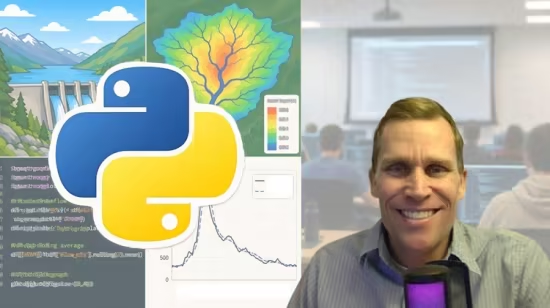
该课程是一门专为水资源、水文及环境科学领域量身定制的 Python 实战进阶指南。课程采取循序渐进的教学方式,首先带你夯实核心编程基础(如变量、条件判断、循环和函数),随后深入学习高效组织环境数据的核心数据结构。重点围绕科研与工程核心需求,教学如何利用 NumPy 进行高效的矩阵与数值计算,运用 Pandas 导入、清洗并深度分析来自 USGS 或 NOAA 等机构的复杂水文时序数据集,借助 Matplotlib 绘制专业的流量历时曲线、水文过程线等工程图表,以及使用 SciPy 解决曲线拟合、地下水插值和管道水力学优化等复杂的工程方程。
所有知识点均通过真实的行业案例(如暴雨径流计算、水质分析和水库调度)进行驱动,旨在帮助无论是零基础的初学者还是希望提升技能的工程师,快速掌握将 Python 转化为自动化数据处理、学术可视化及工程决策的核心工具。
Published 8/2026
MP4 | Video: h264, 1920×1080 | Audio: AAC, 44.1 KHz, 2 Ch
Language: English | Duration: 4h 4m | Size: 4.62 GB
Learn Python Through Practical Examples in Water Resources
What you’ll learn
Write Python programs using variables, data types, conditions, loops, and functions.
Use lists, tuples, sets, and dictionaries to organize your data data.
Automate water resources calculations, data analysis, and visualization.
Use NumPy for mathematical, statistical, and numerical calculations.
Use Pandas to import, clean, analyze, and export water resources data.
Create charts and visualizations of hydrologic and engineering data with Matplotlib.
Use SciPy for curve fitting, optimization, interpolation, and engineering calculations.
Requirements
This course is designed for individuals with a basic computer skills and the desire to learn. Prior experience with programming and water resources would be helpful, but not necessary. No prior experience with Python is necessary. We’ll start with the fundamentals and build from there.
Learn how to program in Python and apply your skills to real-world problems in hydrology, water resources engineering, environmental science, and related fields. Whether you’re completely new to programming or looking to strengthen your existing Python skills, this course provides a step-by-step approach to learning Python through practical examples and engineering applications. You’ll begin with the fundamentals, including variables, data types, operators, conditional statements, loops, functions, and error handling.
As you progress, you’ll explore more advanced Python concepts and libraries commonly used by engineers and analysts. You’ll learn how to work with lists, tuples, sets, dictionaries, and other data structures; read and write files; perform calculations with NumPy; analyze and manipulate engineering datasets with Pandas; create visualizations with Matplotlib; and solve engineering problems using SciPy. Throughout the course, examples are built around water resources applications, helping you understand not only how Python works, but also how it can be used to automate repetitive tasks, analyze data, perform engineering calculations, and develop useful tools.
No prior Python programming experience is required. The course is designed for beginners and gradually builds your programming skills from the ground up. A basic understanding of mathematics and water resources engineering concepts may be helpful but not necessary. Whether you’re a student, engineer, hydrologist, scientist, or water resources professional, you’ll learn Python skills that can be applied to a wide range of technical and engineering problems.
Who this course is for
This course is ideal for beginners new/newish to programming, professionals looking to refresh their skills in Python, and experienced users seeking a practical refresher on Python and how it can be used in Water Resources.
此处内容需要权限查看
会员免费查看