本课程详解UE5蓝图与样条线,教你用向量数学、三角函数构建程序化围墙系统,掌握转角衔接与地形贴合,适合进阶开发者。
原始标题:Unreal Engine 5: Procedural Wall System
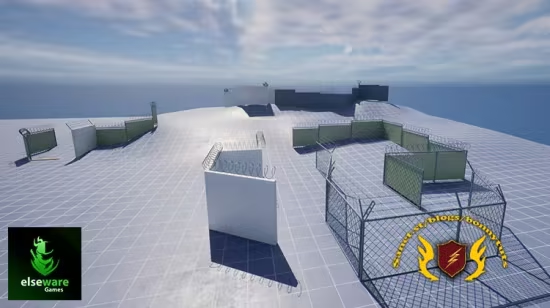
这是一门专注于 Unreal Engine 5 (UE5) 蓝图与样条线(Splines)的进阶级程序化关卡工具开发课程。课程核心围绕“程序化围墙生成系统”展开,旨在教导学员利用向量数学、三角函数、点积与叉积等数学原理,解决模块化网格体沿样条线动态生成时的拉伸、碰撞、多类型适配等核心技术难点。
学员将从零开始构建一个兼具数据驱动与地形感知的工具系统,不仅能完美处理复杂的多角度墙角衔接(Corner Joins),还能实现墙体随地形起伏自动贴合(Landscape Conforming)或主动修改地形(Landscape Deformation)的通用框架。该系统具备极高的复用性,可广泛应用于开放世界、生存、城建及策略类游戏的围墙、栅栏、道路和防御工事等场景的快速搭建,适合希望提升程序化工具开发与数学应用能力的 UE5 开发者。
Published 9/2026
Created by elseware Games, Dhanushka Gunawardhana
MP4 | Video: h264, 1920×1080 | Audio: AAC, 44.1 KHz, 2 Ch
Level: Beginner | Genre: eLearning | Language: English | Duration: 20 Lectures ( 6h 19m ) | Size: 4.5 GB
Build a procedural wall system in Unreal Engine 5 using splines, vector math, corner joins, and landscape controls.
What you’ll learn
⚡ Build a complete procedural wall system in Unreal Engine 5 using Blueprints and splines.
⚡ Generate modular wall meshes dynamically along spline paths.
⚡ Use vector math, trigonometry, dot products, and cross products for procedural calculations.
⚡ Solve wall corner joins using calculated offsets and accurate join positions.
⚡ Create data-driven wall configurations with segment-level overrides.
⚡ Make procedural walls conform to and interact with landscapes.
⚡ Prevent unwanted mesh stretching and support multiple wall types.
⚡ Debug and visualize procedural spline segments effectively.
Description
Master the design and implementation of a flexible, data-driven Procedural Wall System in Unreal Engine 5 using Blueprints, splines, mathematical concepts, and landscape-aware generation techniques.
This course goes beyond simply placing wall meshes along a spline. You’ll learn how to build a complete procedural wall generation system that automatically creates modular walls, fences, barriers, and similar structures while correctly handling segment placement, collisions, corner joins, terrain interaction, mesh stretching, and multiple wall configurations.
Throughout the course, you’ll progressively build the system from the ground up while also learning the mathematical concepts that make advanced procedural generation possible.
Your Learning Journey
✨Spline-Based Procedural Generation – Learn how to generate static meshes along Unreal Engine splines and calculate the start and end positions of individual spline segments.
✨Data-Driven Wall Configuration – Design a flexible system where wall properties can be controlled through structured data, allowing individual wall segments to override default settings when required.
✨Wall Segment Generation – Build top, bottom, and repeated wall segments while controlling their placement, dimensions, and alignment along the spline.
✨Prevent Mesh Stretching – Learn techniques for maintaining consistent wall proportions by dynamically placing modular meshes instead of excessively stretching them across spline segments.
✨Spline Segment Collision – Generate and configure collision for procedural wall sections so that the generated structures can properly interact with gameplay systems.
✨Vector and Trigonometry Fundamentals – Understand vectors, angles, radians, sine, cosine, tangent, and other mathematical concepts required for procedural geometry calculations.
✨Dot and Cross Products – Learn how dot products and cross products are used to understand the relationship between spline directions, angles, orientation, and wall corners.
✨Advanced Corner Joins – Understand the common corner-joining problem that occurs when procedural wall segments meet at different angles. Calculate corner offsets and determine accurate join positions to create cleaner connections.
✨Staggered Wall Generation – Add variation to procedural structures by generating staggered wall arrangements suitable for brick-like or modular construction patterns.
✨Landscape Deformation – Allow your procedural wall system to modify the landscape where necessary to produce more consistent structural placement.
✨Landscape Conforming – Make generated wall sections follow terrain elevation and adapt naturally to uneven landscapes.
✨Multiple Wall Types – Build a reusable system capable of supporting multiple wall styles and configurations without rewriting the core procedural generation logic.
✨Debugging and Visualization – Display segment numbers and useful runtime information to better understand and debug procedural spline generation.
By the end of this course, you’ll have built a complete modular Procedural Wall System that can be adapted for walls, fences, fortifications, barriers, roadsides, architectural structures, and other spline-based environment systems.
More importantly, you’ll understand the theory behind the system instead of simply copying Blueprint nodes. Concepts such as vector direction, trigonometry, dot products, cross products, corner offsets, spline calculations, mesh dimensions, and terrain adjustment will give you a stronger foundation for building your own procedural tools in Unreal Engine.
The techniques covered in this course are directly applicable to environment generation, construction systems, city builders, strategy games, survival games, level-design tools, procedural architecture, and other projects that require dynamically generated modular structures.
Whether you are an intermediate Unreal Engine developer looking to improve your Blueprint and procedural-generation skills or a game developer building reusable environment tools, this course will give you a practical foundation for designing scalable procedural systems in Unreal Engine 5.
Who this course is for
⭐ Unreal Engine developers interested in procedural generation.
⭐ Blueprint developers who want to build reusable environment systems.
⭐ Game developers creating walls, fences, barriers, or modular structures.
⭐ Developers working on strategy, survival, city-building, simulation, or open-world games.
⭐ Intermediate Unreal Engine users who want to improve their spline and procedural-system skills.
此处内容需要权限查看
会员免费查看