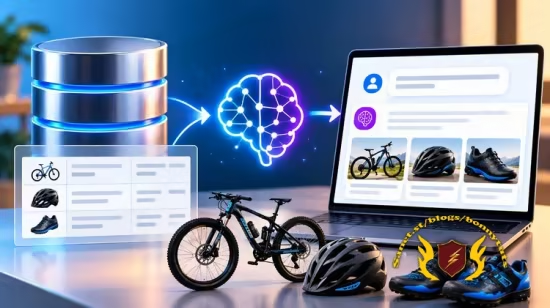
本课程讲解如何用Claude Code与Playwright MCP规划、生成和修复自动化测试,同时建立人类审核防线,防止AI过度修复掩盖真实Bug,涵盖需求分析、代码生成与CI流水线守卫。
原始标题:AI-Powered Playwright: Test Agents, Claude Code & MCP

这门课程聚焦于 AI 驱动的 Playwright 自动化测试,核心教授 QA 工程师如何在利用 AI(如 Claude Code 和 Playwright MCP)高效规划、生成和修复测试代码的同时,建立严格的“人类防线”,防止 AI 因过度修复而掩盖真实的业务 Bug。
在接近 3 小时的实战教学中,学员将通过一个配套的 QA 商城项目,深入掌握从需求分析、原生 TypeScript 代码生成,到 GitHub Actions 自动化流水线守卫的完整闭环,并学会利用 Bug 注入等手段科学衡量 AI 生成测试的真实质量。
Published 10/2026
MP4 | Video: h264, 1920×1080 | Audio: AAC, 44.1 KHz, 2 Ch
Language: English | Duration: 2h 56m | Size: 737.21 MB
Let AI plan, write and heal your Playwright tests without letting it hide real bugs.
What you’ll learn
Plan Playwright test coverage from requirements and app exploration while identifying missing negative cases and invented behavior.
Generate framework-native Playwright tests with reliable locators, assertions, fixtures, page objects, and conformance checks.
Review AI-generated plans, tests, and healer patches so locator fixes pass while assertion changes, skips, and hidden bugs are blocked.
Measure AI test quality using bug-injection scores, coverage, variance, trace analysis, and guarded GitHub Actions workflows.
Requirements
Working knowledge of Playwright and TypeScript; learners should be comfortable reading and running automated browser tests.
Description
This course contains the use of artificial intelligence.
AI can generate Playwright tests quickly, but speed is not the same as trustworthy automation. This course shows QA engineers and test automation teams how to use AI agents to plan, generate, review, heal, and measure Playwright tests while keeping humans in control of test intent.
You will work with Playwright Test Agents, Claude Code, Playwright MCP, playwright-cli skills, accessibility snapshots, fixtures, page objects, traces, GitHub Actions, and practical guardrails. Instead of treating generated code as automatically correct, you will learn how to review AI plans for missing cases, invented behavior, weak assertions, brittle locators, unnecessary waits, and framework violations.
The course includes a complete QA Shop project with checkpoints, prompts, reference runs, answer keys, bug switches, and repeatable agent scenarios. You will see a planner turn requirements and app exploration into a test plan, a generator convert that plan into framework-native TypeScript tests, and a healer repair UI changes. You will also see the dangerous side of healing: assertion changes, expected-value edits, skips, and fixme annotations that can make a pipeline green while a real defect remains.
You will build review gates that separate safe locator and wait repairs from changes that require human approval. You will measure agent output using bug-injection scores, coverage, run-to-run variance, and a human-versus-agent scorecard. The final sections apply these ideas to failure triage, GitHub Actions, Claude project instructions, Copilot guidance, secrets, production-data boundaries, cost controls, and an end-to-end promo-code capstone.
By the end, you will have a practical AI test-automation playbook: agents can do the typing, but your team still owns requirements, assertions, release decisions, and quality.
Who this course is for
QA engineers, test automation engineers, SDETs, and QA leads who want to use AI agents with Playwright without sacrificing test intent or defect detection.
此处内容需要权限查看
会员免费查看