Zeal Vora主理的CKS 2026课程,聚焦CIS基准硬化、RBAC最小特权与Falco运行时检测,通过高密度实战演练助力工程师高效通过认证并提升云原生安全架构能力。
原始标题:CKS: Certified Kubernetes Security Specialist 2026
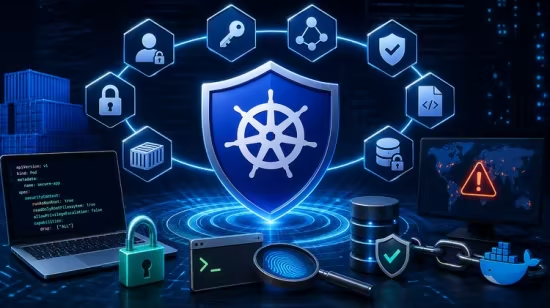
Zeal Vora 主讲的《Certified Kubernetes Security Specialist 2026》是 Udemy 上的高口碑 CKS 备考课程,紧扣官方考纲,主打 CIS 基准硬化、RBAC 最小特权、AppArmor/Seccomp 及 Falco 运行时检测等高密度实战演练。该课程专注于将安全合规转化为生产级动手技能,助力工程师高效通过考试并提升云原生安全架构能力。
Published 7/2026
MP4 | Video: h264, 1920×1080 | Audio: AAC, 44.1 KHz, 2 Ch
Language: English | Duration: 3h 59m | Size: 1.62 GB
Master CKS exam: RBAC, Pod Security, Falco runtime defense, supply chain security & audit logging on real Kubernetes
What you’ll learn
Harden Kubernetes clusters against the CIS Benchmark and pass kube-bench audits with zero critical failures
Design and implement least-privilege RBAC with service account scoping, role boundaries, and audit verification
Enforce Pod Security Standards, OPA Gatekeeper policies, and Kyverno rules to block insecure workloads at admission
Secure the container supply chain using Trivy image scanning, Cosign signing, and registry admission enforcement
Apply AppArmor profiles, Seccomp policies, and Linux capability drops to confine containers at the kernel level
Detect runtime attacks in real time using Falco rules and investigate incidents with Kubernetes audit logs and jq
Encrypt etcd secrets at rest, implement NetworkPolicy default-deny isolation, and configure mutual TLS between pods
Pass the CKS exam with confidence — time management strategy, must-know kubectl commands, and worked scenario walkthroughs
Requirements
Basic Kubernetes knowledge — comfortable with kubectl, pods, deployments, and namespaces (CKA-level or equivalent)
Familiarity with Linux command line — file editing, grep, systemctl, and reading log files
A practice cluster for hands-on labs — kind, minikube, or any kubeadm cluster works
No prior security certifications required — OSCP, CEH, or security experience is helpful but not needed
Description
The Certified Kubernetes Security Specialist (CKS) is the hardest Kubernetes certification — and the most valuable one for engineers who secure production clusters.
This course prepares you for the CKS exam and gives you the hands-on security engineering skills to back up the credential.
What you’ll build and configure
Harden a Kubernetes cluster against the CIS Benchmark from scratch. Design RBAC with true least privilege — scoped service accounts, bounded roles, no wildcard verbs. Enforce Pod Security Standards and OPA Gatekeeper policies that block insecure workloads before they ever reach a node. Lock containers down at the kernel level with AppArmor profiles, Seccomp policies, and capability drops.
Secure your container supply chain with Trivy image scanning, Cosign cryptographic signing, and admission policies that reject unsigned or vulnerable images. Isolate workloads with default-deny NetworkPolicies and mutual TLS. Encrypt etcd secrets at rest with AES-CBC or AES-GCM providers.
Detect attacks in real time with Falco behavioral rules. Investigate incidents with Kubernetes audit logs and jq forensic queries. Build the complete observability stack that makes every API call in your cluster traceable.
Exam preparation built in
Every module maps directly to a CKS exam domain. The final module covers time management strategy, must-know kubectl commands by domain, worked walkthroughs of the five most common examStandards and OPA Gatekeeper policies that block insecure workloads before they ever reach a node. Lock containers down at the kernel level with AppArmor profiles, Seccomp policies, and capability drops.
The Certified Kubernetes Security Specialist (CKS) is the hardest Kubernetes certification — and the most valuable one for engineers who secure production clusters.
This course prepares you for the CKS exam and gives you the hands-on security engineering skills to back up the credential.
What you’ll build and configure
Harden a Kubernetes cluster against the CIS Benchmark from scratch. Design RBAC with true least privilege — scoped service accounts, bounded roles, no wildcard verbs. Enforce Pod Security Standards and OPA Gatekeeper policies that block insecure workloads before they ever reach a node. Lock containers down at the kernel level with AppArmor profiles, Seccomp policies, and capability drops.
Secure your container supply chain with Trivy image scanning, Cosign cryptographic signing, and admission policies that reject unsigned or vulnerable images. Isolate workloads with default-deny NetworkPolicies and mutual TLS. Encrypt etcd secrets at rest with AES-CBC or AES-GCM providers.
Detect attacks in real time with Falco behavioral rules. Investigate incidents with Kubernetes audit logs and jq forensic queries. Build the complete observability stack that makes every API call in your cluster traceable.
Exam preparation built in
Every module maps directly to a CKS exam domain. The final module covers time management strategy, must-know kubectl commands by domain, worked walkthroughs of the five most common exam scenario types, and how to use killer sh effectively in your final week.
Who teaches this
Armaan Sidana — OSCP, CEH, CISA — security instructor with hands-on offensive and defensive experience across cloud-native environments.
If you hold the CKA and want to prove you can secure what you deploy, this is your next course.
—
Course Curriculum
Module 1 — Course Introduction
– Why Kubernetes Security Is Hard
– Real-World Breach: Tesla Cryptojacking Case Study
– CKS Exam Key Facts & Domain Weights
– The Six Security Domains
– Course Module Map
– Setting Up Your Practice Cluster with kind
– The Principle of Least Privilege
– How to Get the Most From This Course
Module 2 — Kubernetes Security Architecture
– Kubernetes Security Architecture Overview
– The Control Plane Attack Surface
– The API Server Request Pipeline
– Critical Security Requirements
– Kubelet Security Configuration
– Cloud Provider Security Considerations
– What Kubernetes Trusts by Default
– Authentication — Who Are You?
– Certificate Authorities in a Cluster
– Module Summary
Module 3 — Cluster Setup & CIS Benchmarks
– Cluster Setup & CIS Benchmarks Overview
– CIS Benchmark Structure
– Must-Disable / Must-Set API Server Flags
– kube-controller-manager Hardening
– etcd TLS Configuration
– CIS-Compliant kubelet Config
– Running kube-bench
– Node Security Requirements
– SHA256 Binary Checksum Verification
– Module Summary
Module 4 — RBAC & Cluster Hardening
– RBAC Overview
– Core RBAC Objects
– Role — Namespace-Scoped
– RoleBinding — Bind to a Namespace
– Disabling Automatic Token Mounting
– High-Risk Permissions
– Common Misconfiguration: Wildcard ClusterRoleBinding
– Auditing RBAC with kubectl-who-can
– Restricting Secret Access
– Module Summary
Module 5 — API Server & Node Security
– API Server & Node Security Overview
– X.509 Client Certificates
– Critical Built-in Admission Controllers
– What NodeRestriction Limits
– SSH Access Controls
– Kubernetes Version Support Policy
– Attack: Unauthenticated Kubelet RCE
– Insecure Features to Disable
– TLS Ingress Configuration
– Module Summary
Module 6 — System Hardening
– System Hardening Overview
– Removing Unnecessary Packages & Services
– AppArmor Modes
– Applying AppArmor to Pods
– Seccomp Profile Types
– Writing a Custom Seccomp Profile
– Default Container Capabilities
– Node-Level Kernel Hardening with sysctl
– Cloud Node IAM Minimum Permissions
– Module Summary
Module 7 — Pod Security Standards & Security Contexts
– Pod Security Standards Overview
– PSA vs PSP: Key Differences
– Enforcement Modes (enforce / audit / warn)
– Pod-Level Security Context
– Enforcing Non-Root Containers
– ReadOnlyRootFilesystem
– Container-Level Security Context
– What Security Settings Do Under the Hood
– Dangerous Volume Types
– Module Summary
Module 8 — OPA Gatekeeper & Policy Enforcement
– OPA Gatekeeper Overview
– What Pod Security Standards Cannot Do — But Gatekeeper Can
– Rego Policy Language Basics
– Installing Gatekeeper
– ConstraintTemplate — Defining the Policy
– Constraint — Enforcing the Policy
– Setting Enforcement Action
– Kyverno Policy — Block Latest Tag
– AllowedRepos with Gatekeeper Library
– Module Summary
Module 9 — Secrets Management
– Secrets Management Overview
– The Real Risks of Kubernetes Secrets
– Encrypting Secrets at Rest (EncryptionConfiguration)
– Minimal RBAC for Secrets
– HashiCorp Vault — Kubernetes Auth Method
– External Secrets Operator Architecture
– How Sealed Secrets Works
– Secret Rotation Strategy
– Module Summary
Module 10 — Container Sandboxing
– Container Sandboxing Overview
– Why Kernel Sharing Is Risky
– gVisor Architecture
– Kata Containers Architecture
– Creating RuntimeClasses
– Common Container Escape Techniques
– Module Summary
Module 11 — Network Security & NetworkPolicies
– Network Security Overview
– NetworkPolicy Key Facts
– Default-Deny All Ingress + Egress
– Ingress & Egress Rule Selectors
– Namespace Isolation Patterns
– Calico & CNI Plugin Security
– Mutual TLS Between Pods
– Module Summary
Module 12 — Supply Chain Security
– Supply Chain Security Overview
– Minimal Base Images
– Secure Dockerfile Patterns
– Trivy — Comprehensive Image Scanner
– Signing Images with Cosign
– Static Analysis Tools for Manifests
– Private Registry Best Practices
– Module Summary
Module 13 — Runtime Security with Falco
– Runtime Security with Falco Overview
– Why Prevention Alone Is Insufficient
– Falco Drivers (eBPF vs kernel module)
– Falco Rule Structure
– Detecting Kubernetes Credential Access
– Preventing Container Drift via Immutability
– Falco Output Channels & Alerting
– Module Summary
Module 14 — Audit Logging & Monitoring
– Audit Logging Overview
– Audit Event Stages
– Audit Policy Levels & Configuration
– High-Priority Audit Events to Alert On
– Log Aggregation with Fluent Bit & Loki
– Forensic Investigation with jq
– Module Summary
Module 15 — CKS Exam Prep & Certification Path
– Exam Prep Overview
– Exam Environment & PSI Browser
– Must-Know kubectl Commands by Domain
– Worked Scenarios: Fix kube-apiserver, AppArmor, etcd Encryption, NetworkPolicy, Audit Policy
– Practice Resources: killer sh & KillerCoda
– Domain Quick Reference
– Thank You & Career Paths After CKS
Who this course is for
Kubernetes engineers and DevOps professionals who want to validate their security skills with the CKS certification
Cloud security engineers moving into Kubernetes environments who need hands-on hardening and policy enforcement skills
CKA holders ready to take the next step — the CKS is the natural progression after the Certified Kubernetes Administrator
DevSecOps engineers who need to implement runtime security, supply chain controls, and audit logging in production clusters
此处内容需要权限查看
会员免费查看