本高阶实战课程教您用Claude AI与开源CAE工具(gmsh+CalculiX)完成卫星结构设计、有限元分析与工程工作流自动化,25年航天专家亲授,打通1U CubeSat从设计到量产全栈技术链。
原始标题:Claude AI for Mechanical Design: Satellite FEA & Beyond
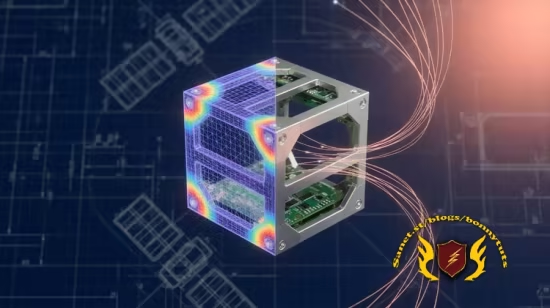
本课程是一门将前沿大语言模型与开源计算机辅助工程(CAE)深度融合的高阶实战课程,专注于解构卫星结构设计、有限元分析(FEA)与 AI 协同工程工作流的底层黑盒。课程由具备25年以上航天工程经验的 Springer 学术专著作者亲授,全面打通从 mission 需求到 1U CubeSat 结构最终量产验证的全栈技术链。
Published 7/2026
Created by gasser gamaz
MP4 | Video: h264, 1920×1080 | Audio: AAC, 44.1 KHz, 2 Ch
Level: All Levels | Genre: eLearning | Language: English + subtitle | Duration: 100 Lectures ( 4h 39m ) | Size: 3.1 GB
Design, mesh and FEA-analyze a real 1U CubeSat with Claude AI — free open-source tools, skills for any mechanical part
What you’ll learn
⚡ Run the full professional FEA workflow — static strength, modal, harmonic and random vibration, and fatigue — with free open-source tools (gmsh + CalculiX)
⚡ Use Claude as your engineering copilot: generate designs from a written brief, safely edit analysis code, and automate engineering reports
⚡ Build parametric models in Python and drive a desktop FEA application (full source code included) that you can extend for your own projects
⚡ Design a complete 1U CubeSat structure — frame, fastening studs, spacers and PCB stack — from mission requirements to finished CAD geometry
⚡ Interpret results like a stress engineer: von Mises stress, margins of safety, effective mass, resonances and Miner cumulative fatigue damage
⚡ Apply the same CAD → mesh → solve → verdict pipeline to any mechanical part: brackets, mechanical frames, housings and machine structures
⚡ Verify a design against real requirements: CubeSat Design Specification checks, deployer interface loads and launch-vehicle frequency floors
Requirements
❗ No prior FEA, aerospace or satellite experience needed — every analysis type is taught from first principles with a worked example.
❗ An undergraduate-level feel for force, stress and vibration helps, but each concept is introduced before it is used.
❗ A computer that can run free engineering tools (Windows 10/11 recommended, ~8 GB RAM is plenty). All software in the course is free and open-source — no ANSYS or paid CAE licences required.
❗ A Claude account — the free tier is enough to follow the core exercises; a paid plan unlocks the hands-on file-editing copilot workflows demonstrated in the final section.
❗ Basic Python familiarity is a bonus, not a requirement — Claude writes and explains the code alongside you, and all source code and solver files are provided ready to run.
Description
This course contains the use of artificial intelligence. AI tools were used to improve presentations and many of the illustrations. The engineering content, the analyses, the results, and all source code are the instructor’s original work.
Design, analyze, and verify a real satellite structure — then put Claude AI to work as your engineering partner.
Taught by the author of the Springer textbook on finite element analysis for satellite structures, with 25+ years in aerospace and mechanical engineering — satellite structures at the Yuzhnoye Design Office and the Egyptian Space Program, and Airbus A380 work at the Virtual Engineering Centre — this course takes you from first principles all the way to a complete structural verification campaign of a real 1U CubeSat, carried out with free, open-source tools and Claude AI.
What makes this course different
✨Real engineering, not toy examples. You follow the same campaign a satellite structure must survive before launch: static strength, modal survey, harmonic (vibration) response, and fatigue — ending with a genuine pass/fail verdict for every component of the CubeSat.
✨A 100% free toolchain. Everything runs on open-source software: Python, Gmsh and the CalculiX solver. No expensive CAE licenses — the skills still transfer directly to ANSYS, ABAQUS or NASTRAN.
✨Claude AI in the loop. You learn a workflow where Claude reads your model files, edits solver scripts, designs new mission configurations and writes engineering reports — while you stay in charge of the physics and the final judgment.
Your journey
✨Sections 0–2 — How satellites are built. The CAE design lifecycle, spacecraft structure types and load paths, materials, attachments, subsystems, and configuring a satellite from mission definition to a packaged spacecraft.
✨Sections 3–4 — The analyst’s toolkit. Finite element fundamentals and the theory of static, modal, harmonic, random-vibration and fatigue analysis, taught the way a practicing stress engineer actually uses them.
✨Section 5 — Hands-on with a real 1U CubeSat. Build the parametric model, mesh it, solve it and interpret it: static strength under launch accelerations, natural frequencies and effective masses, harmonic response at the resonances, and a cumulative-damage fatigue verdict — every step reproducible on your own computer.
✨Section 6 — The AI-driven engineering app. Drive a desktop FEA application built for this course, ask Claude to design missions and generate project files, scale the same structure to 2U and 6U, and learn the guarded-edit workflow that keeps an AI assistant safe inside real engineering code.
Who this course is for
⭐ Mechanical, aerospace and design engineers who want to add AI-assisted workflows and professional FEA to their skill set — without paying for commercial CAE licences
⭐ Engineering students and recent graduates who want a complete, portfolio-ready project: a real satellite designed, analysed and verified end to end.
⭐ University CubeSat team members and small-sat startup engineers who need the exact workflow their mission requires — structural sizing, vibration, and fatigue clearance for launch.
⭐ Engineers and makers curious about Claude who want to see AI applied to real engineering work — generating designs, editing solver code, and writing reports — not just chat demos.
⭐ Simulation and stress engineers from other industries (automotive, machinery, drones) who want a transferable CAD → mesh → solve → verdict pipeline built entirely on open-source tools.
⭐ Educators and self-learners looking for a structured, textbook-grounded course — taught by the author of the Springer textbook on finite element analysis for satellite structures.
⭐ Readers of the author’s Amazon book series “Mechanical Design using Multiphysics and Agentic AI” who want the hands-on video companion — every design and analysis performed live on screen.
此处内容需要权限查看
会员免费查看