本课程教你无硬件环境下,用ROS2、Gazebo与ArduSub搭建自主水下机器人仿真系统,涵盖URDF建模、EKF状态估计、3D声呐SLAM及YOLO视觉检测,打通海洋工程物理AI全闭环。
原始标题:Build an Autonomous Underwater ROV: ROS2, Gazebo, ArduSub
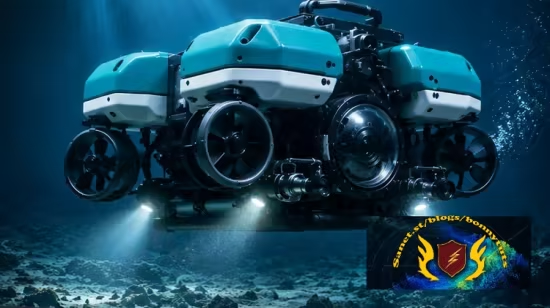
本课程是一门面向水下机器人开发的软硬件全栈实战课,教导学员在无实体硬件的情况下,利用ROS2 Jazzy、Gazebo Harmonic、ArduSub SITL以及QGroundControl从零构建自主水下机器人(ROV/AUV)仿真系统。课程采用“直觉、数学、代码”三层教学法,涵盖ROS2核心通信、URDF物理建模、6自由度推力分配矩阵,以及浮力和流体阻力等复杂水下流体力学仿真。
在高级进阶阶段,课程聚焦于无GPS环境下的定位与智能化巡检。学员将深入学习基于扩展卡尔曼滤波(EKF)的状态估计、利用因子图实现基于3D声呐的SLAM建图,并训练针对浑浊水域优化的YOLO视觉AI模型进行目标探测。最终,通过一个融合了导航、建图与视觉检测的自主巡检毕业项目,帮助学员打通物理AI在海洋工程中的落地全闭环。
Published 7/2026
Created by Ferbin Richard
MP4 | Video: h264, 1920×1080 | Audio: AAC, 44.1 KHz, 2 Ch
Level: All Levels | Genre: eLearning | Language: English | Duration: 87 Lectures ( 3h 51m ) | Size: 2.7 GB
Simulate, pilot, and map a real ROV in ROS2 Jazzy & Gazebo thrusters, sensors, SLAM & AI object detection with ArduSub
What you’ll learn
⚡ Build and simulate an autonomous underwater ROV from scratch using ROS2, Gazebo Harmonic, ArduSub, and QGroundControl — no hardware required
⚡ Pilot a BlueROV2-class vehicle in simulation: thruster control, flight modes, depth hold, and tuning ArduSub parameters through QGroundControl
⚡ Work with underwater sensors — camera, IMU, depth/pressure, and forward sonar — visualizing and recording live data in RViz and rosbag2.
⚡ Build 3D sonar mapping and train an AI vision model to detect underwater targets, then fuse it all into one autonomous inspection mission
Requirements
❗ Build 3D sonar mapping and train an AI vision model to detect underwater targets, then fuse it all into one autonomous inspection mission
Description
This course contains the use of artificial intelligence.
Ever wondered how an underwater robot actually finds its way with no GPS, fights buoyancy and drag to hold a depth, and spots a target through murky water? In this course, you’ll
build and pilot a fully simulated Autonomous Underwater Vehicle (ROV/AUV) from the ground up, using the exact industrial stack real underwater robotics teams run: ROS2 Jazzy, Gazebo
Harmonic, ArduSub SITL, and QGroundControl.
This isn’t a vibe-coding course. Every hard topic is taught in three layers: the intuition (a picture or a live sim demo), the numbers (the actual math, derived plainly), and the
code/config (how it maps to ROS2, Gazebo, and ArduSub, and what breaks when you change it).
You’ll start from zero installing ROS2, Gazebo, and Docker and work up through
– Core ROS2 concepts: nodes, topics, services, parameters, launch files, TF2 frames, and DDS/QoS
– Reading and modifying a real robot’s URDF/Xacro description, including mass, inertia, and collision physics
– Standing up the same Dockerized ArduSub + Gazebo + QGroundControl stack used in real underwater robotics
– Thruster physics and the allocation matrix that maps 6 thrusters to 6 degrees of freedom
– The real hydrodynamics at play: buoyancy, drag, and added mass
– State estimation with an Extended Kalman Filter, and sonar-based mapping with factor graphs and loop closure
– Training and evaluating a YOLO-based object detector for underwater inspection
– A capstone mission where you fuse piloting, mapping, and detection into one autonomous run you own end-to-end
Along the way I share real war stories from building actual underwater vehicles: sign-flip bugs, GPU render crashes, lost degrees of freedom, and false-positive detections in murky water.
By the end, you’ll have hands-on, physics-grounded experience with the same tools and techniques used in real marine robotics and physical AI a strong foundation for further study
or a portfolio-ready capstone project.
Who this course is for
⭐ Build 3D sonar mapping and train an AI vision model to detect underwater targets, then fuse it all into one autonomous inspection mission
此处内容需要权限查看
会员免费查看