本课程系统讲解视觉-语言-动作(VLA)模型,带你用Python构建端到端多模态机器人系统,掌握OpenVLA、RT-2等前沿架构、行为克隆训练、LoRA微调与仿真到真实迁移,适合AI工程师快速转型具身智能。
原始标题:Vision-Language-Action (VLA) Models for AI Robotics
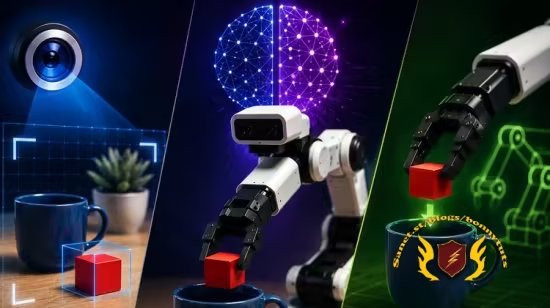
本课程专注于具身智能(Embodied AI)的前沿技术领域,带你从零开始系统化掌握视觉-语言-动作(Vision-Language-Action, VLA)模型的核心架构与实战落地。传统的机器人系统将感知、规划、控制割裂为碎片化模块,而本课程专注于讲解如何利用 Python 构建、训练并部署将环境视觉与人类指令直接转化为物理控制的端到端多模态大模型系统,赋予机器人手脑协同能力。
二、核心学习目标与斩获技能
——————————————————————————–
* 打通端到端 VLA 管道:深刻理解空间图像与文本向量在 Transformer 统一架构中的多模态特征融合,并直接解码输出物理动作。
* 掌握前沿模型架构:深度拆解并复现如 OpenVLA、RT-2 及 π₀ 等行业标杆模型的底层技术栈。
* 实战模仿学习与行为克隆:学习利用专家演示样本,通过行为克隆算法高效训练机器人执行复杂长程任务。
* 低成本微调与泛化:掌握参数高效微调技术,让预训练大模型在有限算力下快速适应全新硬件底座或未知场景。
* 闭环评估与仿真落地:建立完备的评测指标,解决仿真到真实世界的跨越难题,确保高成功率与安全干预机制。
三、课程核心大纲与技术路线
——————————————————————————–
阶段一:具身智能基石(动作空间表征、传感器数据流预处理)
阶段二:多模态对齐与特征融合(视觉编码器、LLM 指令遵循、投影层对齐)
阶段三:行为克隆与模型训练(轨迹数据组织、行为克隆损失函数、动作分块)
阶段四:闭环评测与泛化迁移(闭环控制循环、LoRA 微调、Sim2Real 迁移)
四、适合人群与先修要求
——————————————————————————–
课程面向追求向具身智能转型的人工智能工程师、机器人研发人员及相关研究学者,仅需具备基础的 Python 编程经验和深度学习概念,全流程配有虚拟仿真环境教学。
Published 9/2026
Created by Ferbin Richard
MP4 | Video: h264, 1920×1080 | Audio: AAC, 44.1 KHz, 2 Ch
Level: All Levels | Genre: eLearning | Language: English | Duration: 73 Lectures ( 9h 35m ) | Size: 7.5 GB
Master VLA models, multimodal AI, robot learning, model training, and real-world robotics with Python
What you’ll learn
⚡ Explain how Vision-Language-Action (VLA) models connect visual perception, language understanding, and robotic actions.
⚡ Understand the architecture, training process, datasets, and core components used to build modern VLA systems.
⚡ Build and test VLA-powered robotics applications using Python, AI models, and practical implementation workflows.
⚡ Evaluate, fine-tune, and improve VLA models for reliable performance across real-world robotic tasks.
Requirements
❗ Basic Python knowledge is helpful, but no prior VLA or robotics experience is required. A computer with internet access is sufficient.
Description
This course contains the use of artificial intelligence.
Vision-Language-Action models are changing how robots are built.
Instead of creating separate systems for perception, language understanding, planning, and control, VLA models learn to connect all three: what the robot sees, what a human asks it to do, and what action the robot should take next.
This course takes you inside that pipeline.
You will start with the basic idea behind a VLA model: an image of the robot’s environment and a natural-language instruction go into the model, and a robotic action comes out. From there, we break the system apart and study what is actually happening between those inputs and outputs.
You will learn how visual observations are encoded, how language instructions are represented, how multimodal information is fused, and how a model predicts actions that can be executed by a robot.
We cover the core technologies behind modern VLA systems, including
✨ Vision encoders and visual representations
✨ Transformers and multimodal architectures
✨ Language models for robotic instruction following
✨ Robot action representations
✨ Imitation learning and behavior cloning
✨ Robotics datasets and trajectory data
✨ Fine-tuning VLA models for new tasks
✨ Model inference and action prediction
✨ Evaluation of robotic policies
✨ Deployment considerations for real robots
The course also moves beyond architecture diagrams.
Using practical Python workflows, you will work with the type of data used by robot-learning systems, inspect observations and actions, prepare datasets, run model inference, analyze predicted behavior, and evaluate how well a model performs on robotic tasks.
You will see the complete workflow from
camera observation + language instruction → multimodal model → predicted robot action.
We will also examine where VLA models fail.
Robotics is very different from generating text or images. A wrong token in a chatbot may be inconvenient. A wrong action on a physical robot can damage hardware or create a safety problem.
That means we need to think seriously about dataset quality, distribution shift, generalization, inference latency, action reliability, safety constraints, and what happens when a robot encounters something that was never present in its training data.
By the end of the course, you will understand how Vision-Language-Action models work, how they are trained, how robotics data is represented, how actions are predicted, and how a VLA pipeline can be evaluated and prepared for deployment.
You do not need previous experience with VLA models.
Basic Python knowledge is enough to get started. The course is designed for robotics students, AI engineers, researchers, developers, and anyone who wants to understand how modern multimodal AI is moving from screens into physical robots.
Who this course is for
⭐ AI developers, robotics enthusiasts, students, researchers, and engineers who want to build intelligent robots using Vision-Language-Action models.
百度网盘下载: