本课程专为零编程的架构师与产品经理设计,全面覆盖RAG、多智能体、MCP及企业AI系统生命周期,助您掌握高可用自动化工作流与AI治理,做出顶层商业决策。
原始标题:Complete AI Architecture Bootcamp: From RAG to Agents
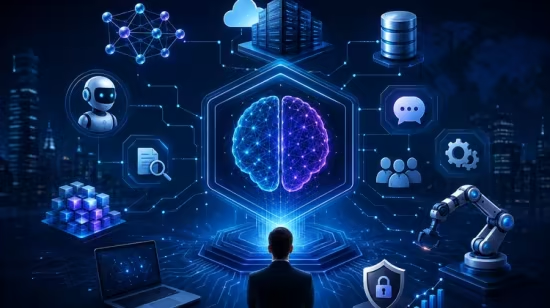
本课程是一门专为架构师、技术领袖及产品经理打造的零编程、企业级 AI 架构师全栈训练营。课程全方位覆盖现代 AI 系统的完整生命周期,核心教授如何利用大语言模型(LLMs)、单/多智能体系统(Multi-Agent)、检索增强生成(RAG)向量知识库以及前沿的 MCP(模型上下文协议) 实现了 AI 与企业 API、数据库及 SaaS 的无缝集成。学员不仅能掌握构建高可用 AI 自动化工作流与“人工环路”机制,还将深度攻克数据隐私、提示词安全、合规性等 AI 治理难题,并最终具备在金融、医疗、零售等行业中评估技术权衡、产出专业 AI 架构提案以及做出“自研或采购”商业落地决策的顶层设计能力。
Published 6/2026
MP4 | Video: h264, 1920×1080 | Audio: AAC, 44.1 KHz, 2 Ch
Language: English | Duration: 8h 37m | Size: 2.59 GB
Build Enterprise AI Solutions with LLMs, Agents, MCP, Automation, Data Platforms, and Security
What you’ll learn
Design complete Enterprise AI Architectures that align business requirements with scalable AI solutions.
Build and evaluate AI Agent and Multi-Agent Systems for automation, decision-making, and workflow orchestration.
Architect Retrieval-Augmented Generation (RAG) platforms using embeddings, vector databases, document ingestion pipelines, and knowledge retrieval systems.
Design and integrate LLM-powered applications using modern models such as ChatGPT, Claude, Gemini, and open-source alternatives.
Create MCP-enabled AI environments that connect AI systems with APIs, databases, SaaS applications, and enterprise tools.
Develop AI Automation Architectures that incorporate human-in-the-loop workflows, monitoring, exception handling, and process optimization.
Design AI-ready Data Architectures including data pipelines, warehouses, lakes, knowledge repositories, and real-time data systems.
Apply AI Security, Governance, and Responsible AI Frameworks to ensure compliance, risk management, auditability, and trustworthy AI deployment.
Architect scalable Cloud and Infrastructure Solutions for deploying AI applications across SaaS, enterprise, hybrid, and edge environments.
Produce professional AI Architecture Documentation, Solution Roadmaps, and Executive Presentations for stakeholders and clients.
Evaluate architectural trade-offs and make informed build-versus-buy decisions for enterprise AI initiatives.
Requirements
No prior AI experience is required. This course is designed to take you from foundational concepts to advanced AI architecture design.
Basic computer literacy and familiarity with common business software and web applications are recommended.
A general understanding of technology concepts such as applications, databases, APIs, or cloud services is helpful but not mandatory.
No programming experience is required, although learners with technical backgrounds may find some topics easier to grasp.
A computer with internet access is required to follow demonstrations, complete labs, and explore AI tools and platforms.
Description
“This course contains the use of artificial intelligence”
Artificial Intelligence is transforming every industry, but most professionals still struggle to understand how modern AI systems are actually designed, integrated, governed, and scaled. This course is designed to bridge that gap by teaching you how to think and operate like anAI Architect. Whether you are a consultant, business analyst, solution architect, technical leader, product manager, engineer, or AI enthusiast, you will learn the frameworks, patterns, and methodologies used to design enterprise-grade AI solutions that deliver real business value.
In this comprehensiveAI Architecture Bootcamp, you will explore the complete lifecycle of building modern AI systems, from initial discovery and requirements gathering through architecture design, deployment, governance, optimization, and long-term maintenance. You will gain a deep understanding of howLarge Language Models (LLMs),AI Agents,Multi-Agent Systems,Retrieval-Augmented Generation (RAG),Vector Databases,Embeddings,Knowledge Systems, andModel Context Protocol (MCP) fit together to create intelligent business solutions.
The course begins by establishing a strong foundation inAI Architecture Fundamentals, helping you understand the differences between traditional software architectures and modern AI-driven architectures. You will learn the core responsibilities of an AI architect and discover how organizations evaluate, design, and implement AI initiatives across the enterprise. From there, you will explore the building blocks of modern AI systems, including front-end interfaces, APIs, databases, integration layers, orchestration services, and cloud infrastructure.
As the course progresses, you will dive into provenEnterprise AI Architecture Patterns, includingAI Assistants,AI Copilots,Standalone AI Applications,Multi-Agent Architectures, and large-scale enterprise AI platforms. You will learn how to evaluate architectural trade-offs, select the right design pattern for different use cases, and build systems that are scalable, maintainable, secure, and aligned with business objectives.
A major focus of the course is modernLLM Architecture andRAG Systems. You will learn how enterprise organizations build knowledge assistants capable of retrieving information from internal documents, databases, and business systems. Topics include document ingestion, chunking strategies, embedding generation, vector search, context injection, grounded response generation, and enterprise knowledge management. By the end of this section, you will understand how to design AI solutions that provide accurate, trustworthy, and context-aware responses.
The course also provides extensive coverage ofAI Agents andMulti-Agent Systems, one of the fastest-growing areas in artificial intelligence. You will learn how agents plan tasks, reason through problems, manage memory, utilize tools, collaborate with other agents, and execute business workflows. You will design architectures that include manager agents, worker agents, escalation mechanisms, orchestration frameworks, and collaborative agent ecosystems capable of supporting complex business operations.
You will then explore the rapidly emerging world ofModel Context Protocol (MCP) and enterprise integrations. Learn how AI systems communicate with external tools, APIs, SaaS applications, databases, and internal business platforms. You will understand how context sharing, resource management, and tool orchestration enable AI systems to become truly useful within enterprise environments.
Beyond AI models and agents, this course teaches the broader architectural disciplines required for enterprise success. You will learnAI Automation Architecture,Workflow Orchestration,Human-in-the-Loop Systems,Data Architecture,Data Pipelines,Knowledge Repositories,Real-Time Data Platforms, andAI-Ready Enterprise Data Ecosystems. These skills will help you design solutions that integrate seamlessly with existing business operations and technology stacks.
Security and governance are critical components of any production AI solution. Therefore, you will learn best practices forAI Security,Prompt Security,Model Protection,Data Privacy,Access Control,Compliance,Responsible AI,Risk Management,Model Monitoring, andAI Governance Frameworks. You will understand how organizations build trustworthy AI systems while managing operational, legal, and regulatory risks.
The course also exploresCloud AI Infrastructure,Deployment Architectures,Scalability Planning,Performance Optimization,Hybrid Architectures,Edge AI, and global deployment strategies. You will gain practical knowledge of how enterprise AI solutions are deployed and managed in real-world environments.
To ensure practical application, the course includes hands-on architecture workshops and design exercises where you will create enterprise AI assistants, multi-agent workflows, RAG platforms, automation systems, AI-ready data architectures, cloud infrastructure designs, and complete client-ready AI architecture proposals. These activities mirror the type of work performed by professional AI architects and consultants.
Finally, you will learn how AI architecture principles are applied across industries, includingCustomer Support AI,Sales AI,Marketing AI,Operations AI,Executive AI Assistants,Healthcare AI,Financial AI,Manufacturing AI,Retail AI, andGovernment AI solutions. By studying these real-world architecture patterns, you will gain the confidence to design AI systems for virtually any business domain.
By the end of this course, you will be able to design end-to-endEnterprise AI Systems, evaluate architectural options, build scalableRAG Platforms, architectAI Agent Ecosystems, integrate AI with enterprise technologies, establish governance frameworks, and communicate architecture decisions to stakeholders and executives. Most importantly, you will develop the mindset and skillset of a modernAI Architect capable of leading AI transformation initiatives in organizations of any size.
Who this course is for
This course is designed for professionals who want to understand how modern AI systems are architected, integrated, governed, and scaled within real-world organizations.
It is ideal for Solution Architects, Enterprise Architects, AI Architects, Technical Leads, Software Engineers, Consultants, Business Analysts, Project Managers, and Technology Leaders who want to develop the skills needed to design enterprise-grade AI solutions.
The course is also valuable for AI Consultants, Digital Transformation Professionals, Product Managers, and Entrepreneurs who need to evaluate AI opportunities, design AI strategies, and communicate architecture decisions to stakeholders and executive teams.
Whether you are building AI assistants, RAG platforms, AI agents, automation systems, or enterprise AI ecosystems, this course provides the frameworks and best practices used by modern AI architecture professionals.
No prior AI architecture experience is required. If you want to move beyond simply using AI tools and learn how to design complete AI systems that deliver business value, this course is for you.
此处内容需要权限查看
会员免费查看