本课程带你纯手写实现11款核心机器学习算法,从梯度下降、反向传播到PCA,通过白板推导与NumPy编码,结合14个真实数据集项目,彻底告别只会调用.fit()的黑盒状态。
原始标题:ML from Zero: Machine Learning, Math & Python from Scratch
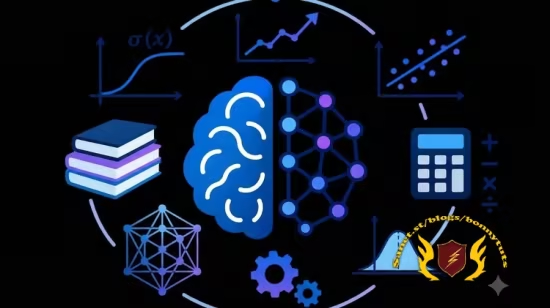
本课程是一门纯手写实现 11 款核心机器学习算法的硬核实战指南,旨在带你告别只会调用 .fit() 的“黑盒”状态,真正攻克算法底层的运行机理。课程零门槛起步(仅需基础 Python 语法,无需微积分或线性代数基础),通过“白板数学推导、纯 NumPy 代码实现、向量化优化、scikit-learn 对标验证”等关键步骤,配合 14 个真实数据集项目,带你从底层彻底攻克梯度下降、反向传播及 PCA 等核心技术,并教你掌握模型调试(如解决梯度消失、数据泄漏)与多维评估的实战能力。
Published 9/2026
Created by Vaibhav Kumar Singh
MP4 | Video: h264, 1920×1080 | Audio: AAC, 44.1 KHz, 2 Ch
Level: Expert | Genre: eLearning | Language: English | Duration: 66 Lectures ( 6h 34m ) | Size: 1.1 GB
Build 11 ML algorithms from scratch in Python and NumPy. Derive the math, code every model, validate vs scikit-learn.
What you’ll learn
⚡ Derive and implement 11 core ML algorithms from scratch in pure Python and NumPy
⚡ Prove your implementations are correct by validating them against scikit-learn
⚡ Read the mathematical notation used in ML papers with confidence
⚡ Build gradient descent, backpropagation and PCA by hand, from the chain rule up
⚡ Complete 14 real-dataset projects, including 3 full end-to-end capstones
⚡ Debug models that train but don’t learn: vanishing gradients, leakage, bad thresholds
⚡ Choose the right algorithm, metric and validation strategy for a real problem
⚡ Understand exactly what happens inside .fit()
Requirements
❗ Basic Python: functions, loops, lists. That’s genuinely it.
❗ No calculus or linear algebra required – Section 2 builds every piece of math the course uses, from nothing
❗ A laptop. No GPU, no cloud account, no paid services
Description
This course contains the use of artificial intelligence.
The lecture narration in this course is produced with a neural text-to-speech voice. Every other part of it is mine: the curriculum, the mathematical derivations, the from-scratch implementations, the projects, the exercises and the test suite were all written and verified by hand.
Every other ML course teaches you to call .fit(). This one teaches you to write it.
Eleven times, for eleven algorithms, in pure NumPy.
Here is the problem with knowing only the API. When your accuracy is 99% and your manager is suspicious. When the model works in your notebook and dies in production. When someone asks why you chose this algorithm and not that one. If all you have ever done is call .fit(), you are guessing.
Every algorithm follows the same six steps
1. The math on the whiteboard, derived rather than hand-waved, and always finished with a worked numeric example.
2. From-scratch code, line by line, with nothing hidden.
3. The vectorized version, the way it is really done, with the speed difference measured.
4. A real dataset: load, train, evaluate, visualize.
5. Validated against scikit-learn, side by side, so you know your code is right.
6. A coding exercise and a quiz, with tests that pass or fail.
What you will build: linear regression, gradient descent, logistic regression, k-nearest neighbours, decision trees, random forests, Naive Bayes, k-means, PCA, and a neural network with backpropagation derived by hand.
Three capstone projects: house-price regression end to end, a classifier on badly imbalanced data, and customer segmentation with k-means and PCA.
And an honest benchmark. The final section puts your code next to scikit-learn on accuracy and on speed, including where we lose by 15 times and exactly why (they use a k-d tree; we do not). Courses that only show wins are marketing. This one shows the gaps and explains them.
No calculus or linear algebra is assumed. Section 2 builds every piece of math the course uses, from nothing. You need basic Python and a laptop.
What you get: 66 lectures, 12 quizzes, 11 graded coding exercises with automated tests, 14 project scripts, and a complete machine learning library you wrote yourself.
Everything is free and offline. No API keys, no cloud accounts, no paid services.
Who this course is for
⭐ Developers who can call .fit() but want to know what’s actually inside it
⭐ Students who hit the math wall in other ML courses and bounced off
⭐ Working engineers preparing for ML interviews
⭐ Anyone who finished a “practical ML” course and felt they learned an API, not a subject
百度网盘下载: