STM32实现SPWM逆变器编程指南
学习使用STM32微控制器编写C代码生成SPWM,实现12V直流转110V交流。含PWM与DMA编程技巧,适合作嵌入式与电力电子开发者。
Published 2/2026
Created by Avinash Kumar Pathak
MP4 | Video: h264, 1920×1080 | Audio: AAC, 44.1 KHz, 2 Ch
Level: All Levels | Genre: eLearning | Language: English | Duration: 10 Lectures ( 41m ) | Size: 794 MB
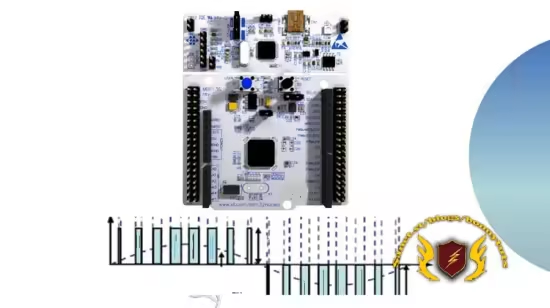
This course gives practical ways to write a c code for generating SPWM using STM32 microcontroller
What you’ll learn
✓ How to generate 110 Volt AC from 12 Volt DC
✓ How to write code for creating PWM for STM32 microcontroller
✓ How to write code for creating PWM using DMA of STM32 microcontroller
✓ How to generate SPWM using STM32 microcontroller
Requirements
● This is project involving high power electronics, you should be a adult to take this course and should have prior exposure to using electronics. If you don’t intend to assemble electronics and want to only use this course for information you can take this course.
Description
This course is designed to equip learners with the knowledge and practical skills required to program Sinusoidal Pulse Width Modulation (SPWM) inverters using the C language. SPWM inverters are a critical technology in modern power electronics, enabling efficient conversion of DC to AC power with minimal harmonic distortion. By combining theoretical foundations with hands-on programming exercises, this course prepares students to design, implement, and optimize inverter systems for real-world applications such as renewable energy integration.
The course begins with an introduction to inverter fundamentals, covering practical ways to generate PWM, SPWM. Learners will then explore the principles of SPWM, including how to generate pulse-width modulated outputs. This theoretical grounding sets the stage for practical implementation using the C programming language.
A major focus of the course is embedded C programming for microcontrollers, where students will learn to configure timers, interrupts, and GPIOs to generate precise SPWM signals. Topics include duty cycle calculation and real-time waveform synthesis. Learners will write modular, reusable C code that can be deployed on popular microcontroller platforms such as STM32.
Hands-on labs and projects form the backbone of the course. Students will be guided to write code in embedded C environments. By the end of the course, learners will be able to design and program robust SPWM inverters and adapt their code for diverse industrial and academic contexts.
此处内容需要权限查看
会员免费查看