ANSYS复材有限元实战:从微力学到结构优化
温莎大学专家亲授,融合复材固体力学与ANSYS仿真工作流。从微观均质化、CLT理论,到ACP铺层与失效分析,最后完成直升机传动轴多目标优化,助你成为高级CAE工程师。
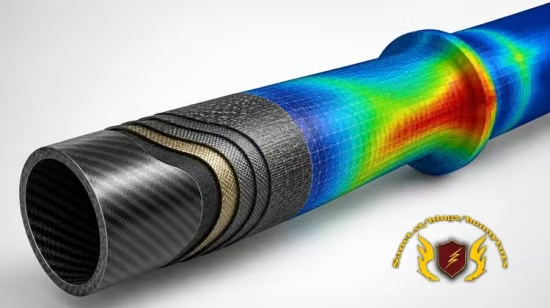
本课程是由加拿大温莎大学(University of Windsor)机械工程系副教授、拥有 20 年复材领域资深经验的 Aleksandr Cherniaev 博士精心打造的 ANSYS 复合材料有限元分析顶尖实战进阶课。课程完美融汇了深厚的复合材料固体力学理论与工业界标准的 ANSYS 数字化仿真工作流。你将从微观纤维/基体的力学分析、ANSYS Material Designer 均质化建模起步,跨越到利用经典层合板理论(CLT)预测宏观本构响应。课程将带你深度攻克 ANSYS Composite PrepPost (ACP) 这一核心高级模块,从零掌握复杂的铺层前处理、网格收敛性控制以及基于 Tsai-Wu 或 Hashin 等准则的失效后处理。最终,你将亲手完成一个直升机传动轴的多约束、多目标结构优化(涵盖振动、屈曲、强度与工艺约束)毕业大项目。本课程不仅教你软件的操作步骤,更着重培养工程审判力(Engineering Judgment),助你完成从普通仿真人员向高级复合材料 CAE 结构工程师的跨越。
Published 6/2026
Created by Aleksandr Cherniaev
MP4 | Video: h264, 1920×1080 | Audio: AAC, 44.1 KHz, 2 Ch
Level: All Levels | Genre: eLearning | Language: English | Duration: 14 Lectures ( 8h 13m ) | Size: 6.4 GB
From Constituent Properties to Lamina Mechanics, Laminate Analysis, Stability, Failure, and Optimization Using ANSYS
What you’ll learn
⚡ Estimate basic composite material properties from constituent data using analytical micromechanical models and ANSYS homogenization tools.
⚡ Analyze the directional behavior of unidirectional composites, including off-axis normal–shear coupling, and model it correctly in ANSYS
⚡ Analyze how laminate layup affects stiffness and deformation using Classical Lamination Theory, ANSYS Mechanical, and ACP (ANSYS Composite PrepPost)
⚡ Evaluate the stability and buckling behavior of composite structures with complex layups in ANSYS
⚡ Interpret failure mechanisms and assess failure in composite structures using engineering criteria, first-ply failure analysis, and ANSYS postprocessing
⚡ Design weight-efficient composite structures in ANSYS using structural optimization subject to manufacturability, vibration, strength, and stability constraints
Requirements
❗ Basic knowledge of mechanics of materials
❗ Introductory familiarity with the finite element method is helpful
❗ No prior experience with composite-material modelling is required
Description
This course provides a structured introduction to the finite element analysis of composite structures, combining the theoretical foundations of composite mechanics (lectures) with practical modelling workflows in ANSYS (tutorials).
The course is designed for engineering students, researchers, and practicing engineers who want to understand not only how to build finite element models of composite structures, but also how to evaluate modelling assumptions and interpret simulation results critically.
The course begins with a focused review of the finite element method and introduces essential modelling practices through a classical stress-concentration problem involving a plate with a hole. You will work with material definitions, shell elements, boundary conditions, symmetry, structured meshing, element order, and mesh-convergence studies.
The following sections cover the micromechanics of composite materials, the mechanics of a unidirectional ply, laminate behavior, buckling, and failure analysis. You will learn how the properties of composite constituents influence the effective properties of a lamina, how stresses and strains are transformed between coordinate systems, how laminate layup affects structural response, and how the strength and failure of composite structures are assessed.
The practical tutorials demonstrate modelling workflows in ANSYS Workbench, Mechanical, Material Designer, Composite PrepPost (ACP), and DesignXplorer.
The final project brings the different topics together through the optimization of a composite helicopter driveshaft. The objective is to minimize structural mass while satisfying strength, buckling, vibration, and manufacturing constraints.
Throughout the course, the emphasis is placed on engineering judgment: understanding what the software calculates, identifying the limitations of a model, and evaluating whether the results are physically meaningful.
The course is taught by Dr. Aleksandr Cherniaev, P.Eng., Associate Professor of Mechanical Engineering at the University of Windsor, Canada, with 20 years of academic and industrial experience in composite materials and lightweight structures.
The instructor gratefully acknowledges ANSYS, Inc. for providing the software license used to prepare and record the tutorials included in this course.
Who this course is for
⭐ Engineering students and researchers seeking a structured introduction to finite element analysis of composite structures
⭐ Mechanical, aerospace, and structural engineers seeking both theoretical foundations and practical ANSYS workflows
⭐ ANSYS users who want to understand the mechanics behind composite-analysis tools, not only the software steps
此处内容需要权限查看
会员免费查看