本课程专为突破AI编程失控瓶颈设计,深度解构三大观测柱石,通过中间件与Guardrails硬编码降本12%,助你从程序员蜕变为企业级AI架构师。
原始标题:Agentic Harness Engineering: Harness Design for AI Engineers
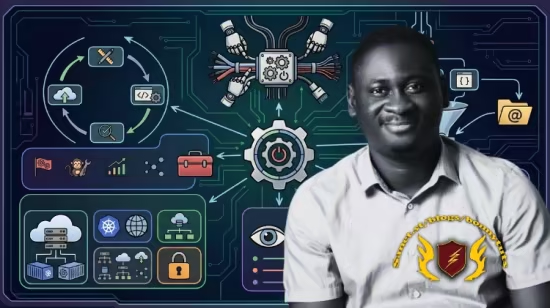
一套直击 AI 自动化编程(Vibe Coding)失控痛点、专为突破“AI 越写越乱、改前坏后”瓶颈而设计的 AI 系统鞍座工程(Harness Engineering) 先锋指南。
课程彻底告别了靠拼运气和疯狂改提示词的低效模式,深度解构了如何通过三大观测柱石(组件、经验、决策)构建自动进化的 AHE 闭环系统,并将核心业务制约与安全边界从不稳定的提示词层解放出来,通过中间件与工具硬编码(Guardrails)沉淀为基础设施,在实现无缝跨模型迁移的同时,大幅削减 12% 的 Token 成本;其最大特色在于教导学员如何建立一套基于 LLM 的错误根因自动提取与断言预测契约(Manifest)运维体系,为 AI 智能体打造一套无懈可击的运行温床与防崩溃安全网,助力开发者正式从“调用工具的程序员”蜕变为“能够驾驭生产级多智能体流水线的企业级 AI 架构师”。
Published 7/2026
Created by Fikayo Adepoju
MP4 | Video: h264, 1920×1080 | Audio: AAC, 44.1 KHz, 2 Ch
Level: Beginner | Genre: eLearning | Language: English | Duration: 23 Lectures ( 4h 35m ) | Size: 2.4 GB
Harness Engineering for Long-Running, Code Executing, and Persistent AI Agents like Claude Code, Codex, and OpenClaw
What you’ll learn
⚡ Build a Complete Harness: Design and implement a multi-layered agent harness from scratch using raw Python and custom execution loops.
⚡ Implement Multi-Session Memory: Utilize the AGENTS[dot]md memory file standard alongside vector-indexed retrieval for persistent, cross-session recall.
⚡ Defeat Context Rot: Implement advanced compaction hooks and tool call offloading middleware to sustain model performance over long runs.
⚡ Secure Code Execution: Engineer isolated Docker sandboxes with execution timeouts, command allow-lists, and restricted outbound networks.
⚡ Optimize with LangSmith Tracing: Build a rigorous evaluation harness to profile agent traces, diagnose failures, and measure benchmark pass rates.
⚡ Orchestrate Long-Horizon Tasks: Deploy the “Ralph Loop” to intercept premature agent exits and enforce goal-driven, autonomous continuity.
Requirements
❗ Python Proficiency: Strong comfort with advanced Python syntax, file handling, and structural logic.
❗ LLM Foundations: Basic familiarity with Large Language Models, chat APIs, and the fundamental mechanics of prompting.
❗ Environment Tools: Comfort using the command line (Bash) and a local development machine with Docker installed for sandboxing.
Description
Welcome toAgentic Harness Engineering: Harness Design for AI Engineers, the definitive, production-grade masterclass for developers ready to build the infrastructure that makes artificial intelligence truly useful. As Vivek Trivedy of LangChain noted,“The model contains the intelligence. The harness is the system that makes that intelligence useful.” While most developers are stuck building fragile, prompt-dependent wrappers, this course focuses on the system design discipline of agent engineering—teaching you how to design, build, and optimize a customagent harness from scratch.
Through a rigorous, step-by-step curriculum, you will incrementally build a complete, production-ready infrastructure layer from scratch usingPython and Docker. You’ll start by constructing a robust conversation skeleton and a secure filesystem layer using a versioned Git workspace and custom memory patterns. From there, you will escalate to creating a secure code execution engine inside isolated Docker sandboxes, incorporating advanced self-verification test loops and network isolation.
As your agents take on long-horizon tasks, you will engineer cutting-edge context management systems—includingcompaction hooks, tool call offloading, and progressive tool disclosure—to actively defeat context rot. Finally, you will implement parallel subagent spawning and the advanced“Ralph Loop” to force autonomous continuation. To wrap up your architectural mastery, you will connectLangSmith to build an evaluation harness, running optimizations against live benchmarks. Stop fighting raw model limitations and start engineering high-autonomy agent systems built for the real world.
Who this course is for
⭐ AI Engineers and Software Developers wanting to build production-grade, highly autonomous agent infrastructure instead of fragile prompt wrappers.
⭐ Backend and Infrastructure Engineers who need to implement secure, sandboxed code execution environments and scalable multi-agent systems.
⭐ Technical Architects looking to master context management, memory state persistence, and enterprise-level AI observability.
此处内容需要权限查看
会员免费查看