本课程基于MuJoCo仿真,深入讲解人形机器人的平衡与行走控制,从力矩控制、ZMP到强化学习步态,适合Python和线性代数基础学习者,无需硬件即可掌握核心算法。
原始标题:Humanoid Robotics 2026: Balance, Walking & RL in MuJoCo
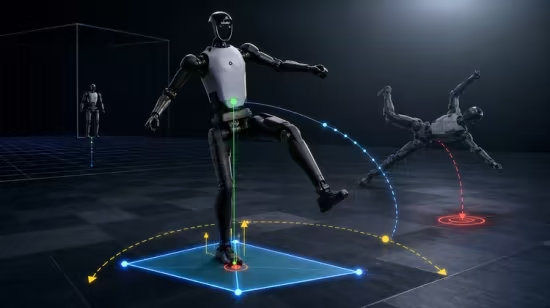
这门硬核的人形机器人课程基于MuJoCo仿真环境,围绕Unitree H1-2机器人展开,深入讲解从质心估计、线性倒立摆(LIPM)到全身二次规划(Whole-Body QP)的经典平衡与行走控制流 。课程同时结合强化学习步态策略与ROS 2工程实战,展现了“实证教学”的理念,专注于解决推力恢复与复杂地形适应等核心课题 。
该课程拒绝理论堆砌,通过对位置控制失败的真实分析,带领学员实操高难度平衡与步进控制,对硬件无要求,仅需Python与线性代数基础即可在普通笔记本上进行学习 。通过从零构建完整算法,该课程旨在帮助机器人工程师和编程爱好者将理论转化为实际力矩控制代码。
Published 8/2026
MP4 | Video: h264, 1920×1080 | Audio: AAC, 44.1 KHz, 2 Ch
Language: English + subtitle | Duration: 8h 51m | Size: 6.57 GB
Build humanoid balance and walking control for a Unitree H1-2 in MuJoCo: torque control, ZMP, push recovery and RL.
What you’ll learn
Build a balance controller for a 67 kg Unitree H1-2 humanoid in MuJoCo, from torque control and gravity compensation to a measured ankle strategy.
Estimate centre of mass and centre of pressure from model and sensor data, and use them to keep a humanoid standing against a measured push disturbance.
Make a humanoid walk: LIPM trajectories, foot placement, swing-leg inverse kinematics and a whole-body QP that turns those trajectories into joint torques.
Run and read a reinforcement learning locomotion policy, compare it against your classical stack, and take both to ROS 2 and Gazebo in a full capstone.
Requirements
Python and basic linear algebra. No robot and no prior humanoid experience needed: everything runs in MuJoCo on a normal laptop, and the robot model is free.
Description
This course contains the use of artificial intelligence.
A humanoid robot has a support polygon the size of a shoe. That is the whole problem.
A wheeled robot can stop and stand still. A humanoid standing still is running a controller, and if that controller stops, it falls.
This course builds that controller from the ground up using theUnitree H1-2 humanoid inMuJoCo, entirely in simulation. You do not need physical hardware, and this is not a slide deck about robots someone else built.
We start by breaking it.
Hold every joint at its exact angle, let go, and the robot collapses from1.03 m to 0.415 m in six seconds.
That measured failure drives everything that follows: why position control cannot balance a humanoid, what torque control actually gives you, and why gravity compensation alone does not solve the problem.
What You Will Build
You will progressively build the humanoid balancing and locomotion stack
– Estimatecenter of mass from the robot model and state
– Estimatecenter of pressure from ankle force/torque sensors
– Derive and implement theankle strategy, then push-test it to find where it fails
– Build anupper-body momentum strategy suited to the H1-2
– Implementcapture-point stepping and determine reachable foot placements
– Generate walking trajectories using theLinear Inverted Pendulum Model
– Solveswing-leg inverse kinematics
– Build awhole-body quadratic program that converts motion objectives into joint torques
– Run Unitree’spre-trained reinforcement-learning locomotion policy
– Break down its47-dimensional observation vector term by term
– Compare a learned locomotion policy against the classical controller you built yourself
– Extend the system toterrain, arms, and hands
– Integrate the system withROS 2 and Gazebo
– Finish with a capstone where the humanoidwalks, balances, and carries
Learn From What Fails
Every number shown in the course comes from an experiment.
When something does not work, we study why instead of hiding it. That includes gravity compensation that made the robot perform worse and a textbook hip strategy that this particular humanoid cannot execute in the conventional way.
You receive the scripts used to produce the experiments and figures, so you can rerun them, modify them, and test the results yourself.
What You Need
Required: Python, basic linear algebra, and a laptop.
Not required: a humanoid robot, ROS experience, or previous humanoid robotics experience.
Who this course is for
Robotics engineers and ML practitioners who can code in Python and want humanoid balance and locomotion built from measured results, not slide-deck theory.
此处内容需要权限查看
会员免费查看