物理AI实战指南:从原理到部署
掌握物理AI的机制、商业逻辑与部署实践,无需深奥公式。学习传感→决策→行动的核心循环,利用机会测试与自主阶梯评估真实AI机会,适合各层次学习者。
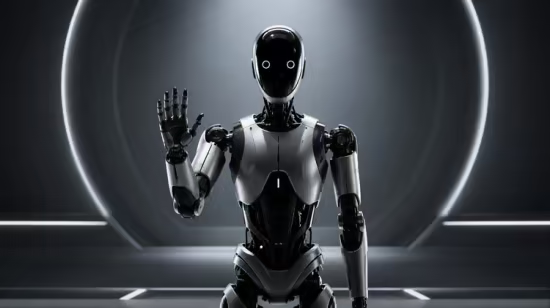
Published 5/2026
MP4 | Video: h264, 1920×1080 | Audio: AAC, 44.1 KHz, 2 Ch
Language: English + subtitle | Duration: 4h 50m | Size: 2.45 GB
Master the mechanisms, business logic, and deployment realities of Physical AI without drowning in equations or jargon
What you’ll learn
What Physical AI is and how it differs from Information AI, robotics, and automation
Why Physical AI must be judged by consequence, not just intelligence
How the core robotic intelligence loop works: Sense → Interpret → Decide → Act → Correct
How to evaluate real Physical AI opportunities using the Opportunity Test, Autonomy Ladder, and Economics Triangle
Requirements
The course is tool-agnostic and focuses on thinking frameworks. If you can type into ChatGPT (or similar), you can do everything in this course.
Description
“This course contains the use of artificial intelligence.”
AI is leaving the screen.
For years, most people experienced AI as something that writes, summarizes, predicts, generates, recommends, or analyzes. But the next frontier is different.
Physical AI is what happens when intelligence enters the real world through robots, autonomous machines, drones, vehicles, humanoids, factory systems, agricultural robots, hospital robots, and smart machines that cansense, interpret, decide, act, and correct.
This course teaches you how robotic intelligence actually enters reality.
You will learn why Physical AI is not simply “ChatGPT with wheels.” A chatbot can be wrong and regenerate. A robot can be wrong and hit something, drop something, block a hallway, damage a product, waste chemicals, or create safety risk.
That difference changes everything.
What You Will Learn
In this course, you will learn how to think clearly about Physical AI from both a technical and strategic perspective.
You will understand
– What Physical AI is and how it differs from Information AI, robotics, and automation
– Why reality is harder than text
– Why Physical AI must be judged by consequence, not just intelligence
– How the core robotic intelligence loop works:Sense → Interpret → Decide → Act → Correct
– What sensors allow machines to detect
– How machine learning turns raw sensor data into action-ready meaning
– How robots choose the safest useful next move under uncertainty
– Why action is where intelligence becomes physical consequence
– Why feedback is the heartbeat of adaptive robotic systems
– How simulation, training, edge compute, deployment, and RoboOps make Physical AI work in reality
– How to evaluate real Physical AI opportunities using the Opportunity Test, Autonomy Ladder, and Economics Triangle
Why This Course Matters
Most AI courses teach digital AI.
They teach prompts, chatbots, automation, content generation, or data analysis.
This course teaches something different
How intelligence enters the physical world.
Physical AI is harder because the real world pushes back.
Robots must deal with latency, compute limits, battery life, heat, noisy sensors, friction, contact, movement, uncertainty, human behavior, safety, and recovery.
A model can be impressive in the lab.
A robot must survive Monday morning.
This course gives you the mental models to understand that shift.
此处内容需要权限查看
会员免费查看