ARM TrustZone与RTOS嵌入式系统架构大师课
掌握ARM TrustZone安全分区、RTOS实时调度与TinyML边缘推理,构建符合EU-CRA合规的零故障固件。适合中级工程师备考航空航天及国防领域技术面试。
Published 5/2026
Created by Bayt Al Hikmah
MP4 | Video: h264, 1920×1080 | Audio: AAC, 44.1 KHz, 2 Ch
Level: Intermediate | Genre: eLearning | Language: English | Duration: 112 Lectures ( 8h 6m ) | Size: 1.65 GB
Master Zero-Failure logic, TinyML, and EU-CRA Compliance.
What you’ll learn
⚡ Architect mission-critical firmware capable of passing the most rigorous technical interviews at Tier-1 aerospace and defense conglomerates.
⚡ Deploy hardware-rooted security using ARM TrustZone-M to partition “Secure” and “Non-Secure” execution environments on the latest STM32 silicon.
⚡ Master deterministic RTOS orchestration, including preemptive scheduling, mutexes, and priority inversion avoidance in FreeRTOS and Zephyr.
⚡ Integrate quantized TinyML models (INT8) for localized machine learning inference and acoustic anomaly detection at the edge.
⚡ Implement zero-trust Firmware-Over-The-Air (FOTA) pipelines that comply with the 2026 EU Cyber Resilience Act reporting mandates.
⚡ Design deterministic memory management systems using static allocation and Memory Protection Units (MPU) to prevent silent corruption and heap fragmentation.
⚡ Audit system power consumption and thermal throttling logic to achieve 10-year battery life for autonomous industrial sensors.
Requirements
❗ Firm C Foundation: Proficiency in C programming (pointers, structures, and bitwise manipulation) is mandatory.
❗ Hardware: You will need an STM32 B-U585I-IOT02A Discovery Kit (recommended for TrustZone/Edge AI) or an STM32H5 Nucleo-144 board.
❗ Software: A computer capable of running STM32CubeIDE (Windows, macOS, or Linux) and a basic 8-channel logic analyzer for electrical verification.
❗ Mindset: A commitment to the “Zero-Failure” philosophy. We do not use malloc() or rely on HAL-layer “black boxes” here.
Description
This course contains the use of artificial intelligence.
We only charge a fee solely for the time invested in building this comprehensive curriculum.
In 2025, the industry was captivated by “Vibe Coding”—the ability to prompt an AI into generating a working demo in seconds. But by 2026, the elite engineering market has realized the “Zero-Failure” truth: a demo that runs is not a system you can live with. In mission-critical environments—autonomous vehicles, aerospace, and medical robotics—software does not simply “crash.” It results in multi-billion-dollar liabilities or the loss of human lives.
The market for generic firmware developers is shrinking, but the demand forPrincipal Embedded Architects has reached a fever pitch. With the global embedded market projected to reach $200 billion by 2032.
The Solution: A 100-Lab Journey to Mastery
This is not a theoretical lecture series. It is a grueling, 100-lab technical gauntlet designed to bridge the gap between “Arduino tinkering” and “Sovereign Engineering.” We strip away the abstractions of the HAL (Hardware Abstraction Layer) to teach you the “Production-Grade” truth of the silicon.
✨Modules 1-3 (Foundations): You will write your own startup files and linker scripts, dictating every byte of memory and establishing hardware-level control through JTAG/SWD debugging “.
✨Modules 4-5 (Orchestration & Security): You will move beyond bare-metal to master deterministic RTOS scheduling and ARM TrustZone-M. You will learn to partition your MCU into “Secure” and “Non-Secure” worlds, isolating cryptographic keys from your main application logic[17, 18].
✨Modules 6-8 (Edge AI & Compliance): You will deploy quantized TinyML models for acoustic anomaly detection and implement networking stacks (lwIP/MQTT-SN) that comply with the mandatory 2026 EU Cyber Resilience Act (CRA) reporting requirements[6, 4].
The Climax: The PhD-Level Capstone (Lab 100)
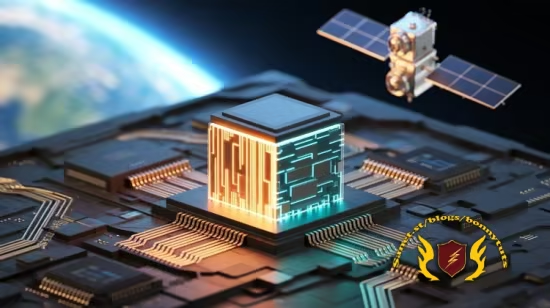
The journey concludes with theAutonomous Orbital Micro-Satellite Subsystem. You will architect a complete Attitude Determination and Control System (ADCS) simulating a Low-Earth Orbit environment. Your firmware must utilize ARM TrustZone for ground-station authentication, execute a deterministic control loop in FreeRTOS, and autonomously recover from simulated radiation-induced memory faults.
The “Zero-Failure” standard is no longer optional—it is a legal and economic mandate. Whether you are aiming for a career pivot or seeking to harden your current engineering practices, the time to master sovereign architecture is now.Enroll today and begin building the infrastructure of 2026.
此处内容需要权限查看
会员免费查看